
01 Natural Stone Countertops and Tiles (Marble, Limestone, and Travertine)
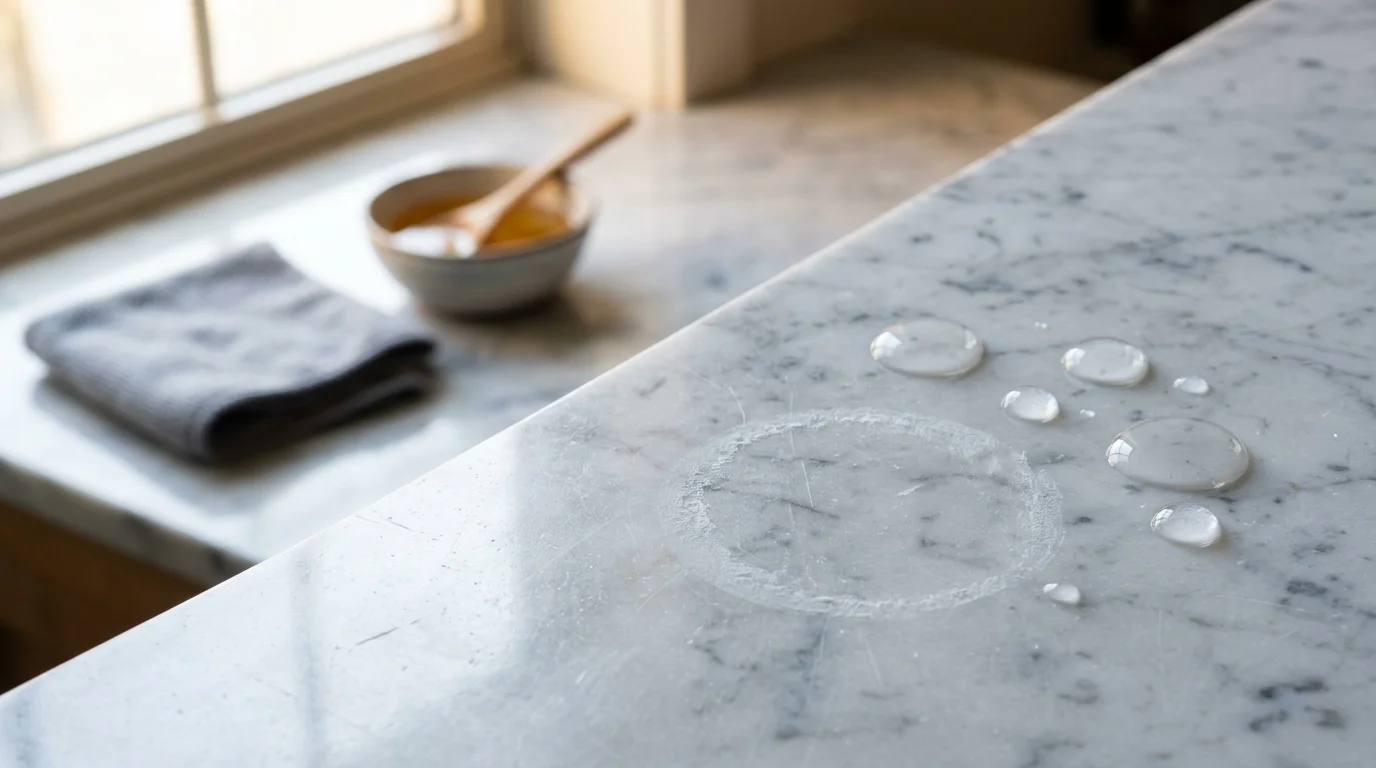
Natural stone surfaces bring warmth and elegance to kitchens and bathrooms, but they represent the primary things not to clean with vinegar. Calcium-based stones—such as marble, travertine, limestone, and onyx—contain high concentrations of calcium carbonate ($CaCO_3$). When acidic vinegar touches calcium carbonate, an immediate chemical reaction occurs:
$$CaCO_3 + 2CH_3COOH \rightarrow Ca(CH_3COO)_2 + H_2O + CO_2$$
This reaction dissolves the top layer of the stone in seconds, a process known in the restoration industry as “etching.” Etching produces dull, cloudy, or chalky white marks that look like water rings or stains. Because etching is physical corrosion rather than surface grime, you cannot wipe or wash it away; you must hire a stone restoration specialist to grind and polish the surface mechanically.
Granite countertops have a different geological composition than marble, but they remain vulnerable. Most granite installations rely on silicone- or fluoropolymer-based impregnating sealers to prevent oil and moisture from penetrating the porous rock. Acidity strips these protective sealers over time, leaving your granite exposed to deep stains from wine, coffee, and cooking oils.
Safe Alternatives for Natural Stone
- Daily Maintenance: Mix two drops of mild, pH-neutral liquid dish soap with warm tap water in a clean spray bottle. Wipe down the counter with a soft, non-abrasive microfiber cloth.
- Dedicated Stone Cleaners: Use a specialized pH-neutral stone cleaner formulated specifically to protect both the mineral structure and the underlying sealant.
- Disinfection: Wipe the stone with 70% isopropyl alcohol, let it sit for three minutes to eliminate bacteria, and wipe dry.




Great information! Thank you
show the damn 5 surfaces
I agree. My Mother cleaned everything with vinegar. It’s the only thing she used.
Right! Because I have vinegar in my Instcart coming to do my floors.
can you clean stains in a kitchen sink with vinegar?
Fill your stainless steel sink halfway with warm water & pour in a cup of bleach!
Toss in ALL your cutlery (unless they’re sterling silver), & while you’re at it, put any badly stained coffee/tea mugs in there too. Let them all soak for a couple hours, empty bleach water, then do dishes as usual with dishsoap.