Overwashing ruins your clothes faster than daily wear, yet delaying key washes invites bacteria, odors, and allergens. Knowing how often to do laundry protects delicate fibers, lowers utility bills, and streamlines your weekly routine.
Even with concentrated detergents and modern machines, the average American family still runs about 300 loads of laundry per year. That habit wastes water, wears down textiles, and steals hours from your week.
Use this research-backed laundry schedule, fabric-sorting system, and commercial-grade machine checklist to cut unnecessary cycles. You will get cleaner clothes, longer-lasting linens, and lower monthly bills.
Why Overwashing Destroys Textiles and Inflates Utility Bills
Every wash and dry cycle subjects fabric to mechanical flexing, chemical stripping, and thermal stress. When you toss lightly worn garments into the hamper out of habit, you accelerate fading, pilling, and elastic failure.
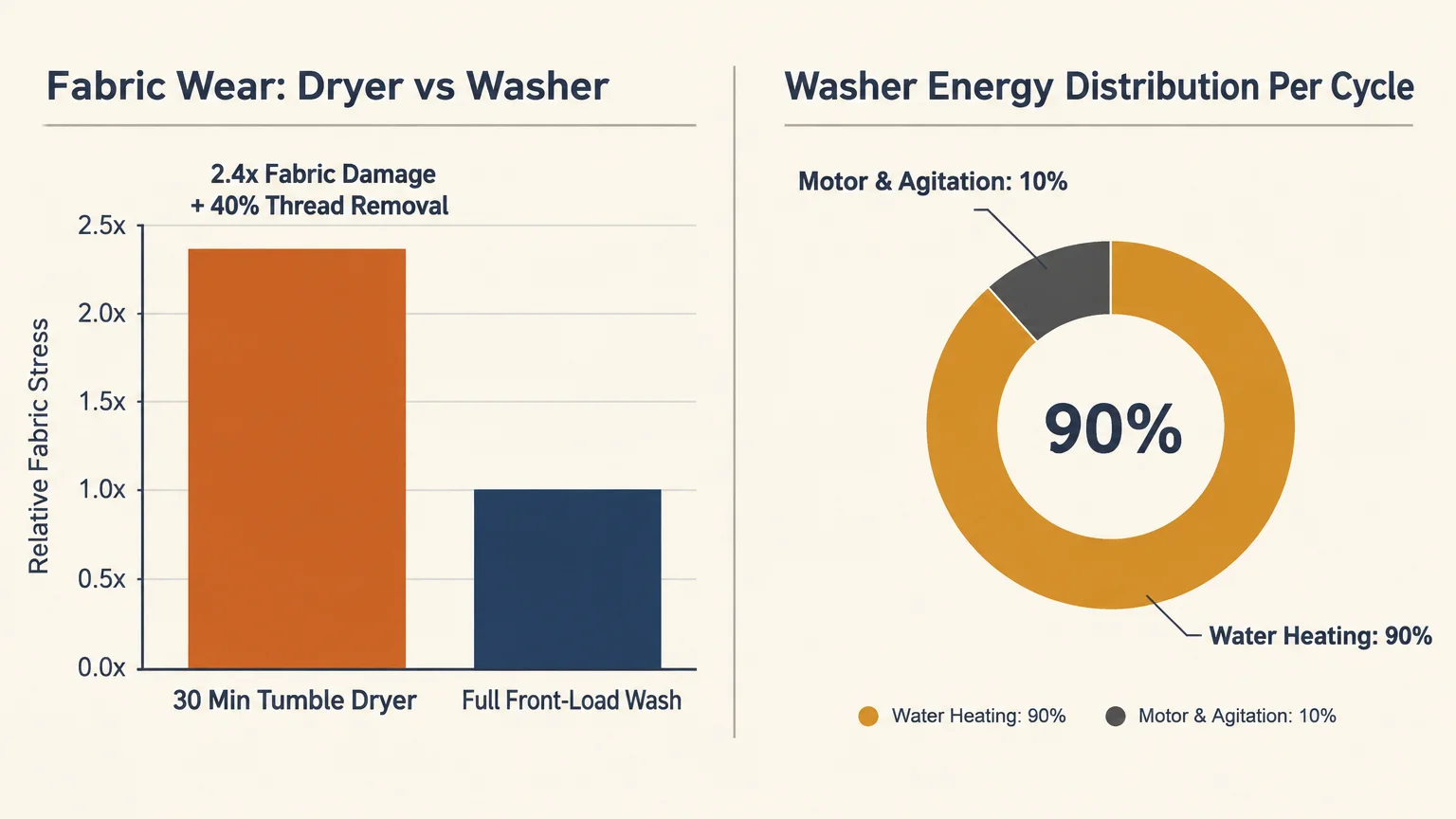
Dryer heat causes even greater structural damage than washing alone. Testing by Whirlpool submitted to the U.S. Department of Energy (DOE) in February 2024 found that 30 minutes of tumble drying semi-saturated fabric caused 2.4 times the fabric damage of a full front-load wash.
Under that Appendix D2 testing protocol, half an hour in the dryer produced 40% thread removal. Reducing unnecessary wash loads automatically eliminates those extra drying cycles, keeping collars crisp and stretch fabrics supportive.
Americans have actually begun dialing back wash frequency over the past two decades. U.S. DOE analysis of Residential Energy Consumption Survey data shows average washer usage fell from 292 cycles per year in 2005 to 210 cycles in 2020, while household size stayed near three people.
Water Demand Management data cited by the DOE reflects a similar shift, dropping from 0.81 loads per day in 1999 to 0.71 loads per day in 2023. Still, ENERGY STAR notes that typical American families average nearly 6 loads weekly.
Every avoidable load drains household resources right along with fabric lifespan. According to EPA WaterSense, laundry accounts for roughly 17% of indoor residential water consumption in a home using about 300 gallons per day.
Energy waste compounds that water bill, especially when you wash in warm or hot water. Both ENERGY STAR and the U.S. DOE confirm that heating water consumes about 90% of a washing machine’s energy per cycle, leaving only 10% for the motor.
The Expert Laundry Schedule: How Often to Wash Every Item
Professional textile care relies on skin-contact exposure, moisture retention, and fiber recovery time rather than arbitrary weekly rules. Garments sitting directly against sweat glands require immediate laundering, while outer layers benefit from airing out between wears.
At the same time, many households swing too far in the opposite direction with bedding. A Mattress Advisor survey of 1,000 people found respondents wash bed sheets only once every 24.4 days on average, with men waiting 10 days longer than women.
Human bodies shed skin cells and produce roughly 26 gallons of sweat in bed each year, notes NYU School of Medicine microbiologist Philip Tierno. Within just one week, microbial and allergen buildup on sheets reaches significant levels.
Use the schedule below to balance textile preservation with genuine household hygiene across your wardrobe and linens.
| Item Category | Recommended Wash Frequency | Expert Care Rationale |
|---|---|---|
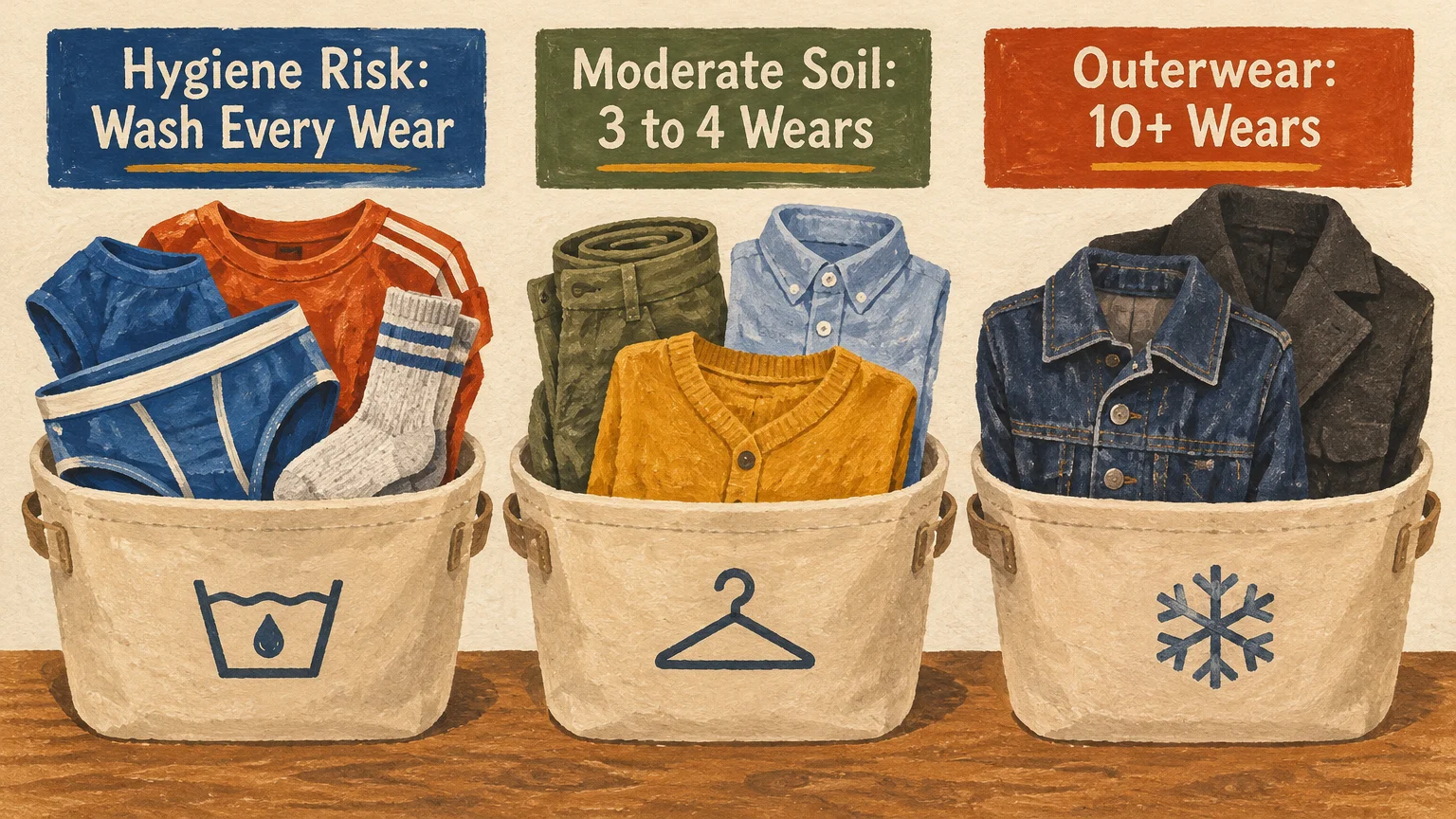
| Underwear, socks, T-shirts, tank tops, camisoles | After every wear | Direct contact with sweat, body oils, and skin flora causes rapid odor and fiber degradation (American Cleaning Institute; Utah State University Extension). |
| Leggings, tights, workout gear, swimsuits | After every wear | Sweat salts, chlorine, and sunscreen break down elastane filaments unless rinsed promptly (American Cleaning Institute). |
| Whites and silk garments | After every wear | Invisible perspiration oxidizes into permanent yellow stains if left sitting in a hamper (American Cleaning Institute). |
| Everyday bras | After 2 to 3 wears | Rest bras at least one full day between wears so spandex fibers recover their tension; wash sports bras after 1 wear (American Cleaning Institute). |
| Jeans and denim | After 3 to 4 wears | Spot-clean minor marks and air-dry between uses to preserve indigo dye and cotton twill structure (American Cleaning Institute; Utah State University Extension). |
| Pajamas | After 3 to 4 wears (or weekly) | Stretch slightly beyond 4 wears if you shower right before bed, or wash once weekly to control dead skin buildup (American Cleaning Institute; Good Housekeeping). |
| Wool and synthetic suits (dry clean) | Wool: 3 to 4 wears; Synthetics: 4 to 5 wears | Brush surface dust with a soft garment brush and steam lightly unless stained or exposed to heavy odors (American Cleaning Institute). |
| Bath towels | After 3 to 5 normal uses (weekly; 2 to 3 times weekly in humid homes) | Spread towels flat on a bar to dry completely between uses so mildew cannot colonize damp loops (American Cleaning Institute; Cleveland Clinic). |
| Hand towels and kitchen dish towels | Every 1 to 2 days | Frequent dampness and food-prep contact make kitchen and bath hand towels prime bacterial transfer points (Utah State University Extension; NSF). |
| Bath mats | Weekly | Wet footprints and bathroom humidity trap grit and fungal spores inside dense backing (Utah State University Extension). |
| Bed sheets and pillowcases | Every 7 to 10 days (at least every 2 weeks; every 3 to 4 days with pets in bed) | Frequent washing clears dust mite allergens, pet dander, and facial oils, especially during summer or allergy flare-ups (Sleep Foundation; Good Housekeeping Institute; American Cleaning Institute). |
| Duvet covers | Every 2 weeks to 1 month | Acts as a sacrificial barrier protecting bulky down or synthetic inserts from frequent agitation (Sleep Foundation). |
| Mattress protectors | Every 1 to 2 months | Captures moisture before it reaches upholstery foam; follow waterproof membrane temperature limits (Sleep Foundation). |
| Comforters, blankets, washable pillows | Every 2 to 6 months (or 1 to 2 times per year for light-use guest bedding) | Wash comforters every 2 to 3 months and pillows every 4 to 6 months in heavy-use bedrooms, or 1 to 2 times yearly for seasonal pieces (Sleep Foundation; Utah State University Extension). |
Why Hanging Method Dictates Towel Longevity
Towel frequency depends heavily on airflow between showers. Folding a damp bath sheet over a narrow hook traps moisture inside dense terry loops, creating sour odors after just two uses.
Instead, drape each towel across a wide bar so air circulates over both surfaces. In humid climates or windowless bathrooms, run your exhaust fan for 20 minutes after showering and stick to washing towels two to three times per week.
The One-Day Rest Rule for Elastic and Knitwear
Synthetic stretch fibers—found in bras, waistbands, and fitted sweaters—elongate under body heat and tension. Wearing the exact same bra two days in a row prevents elastane from snapping back to its resting length.
Rotate two or three everyday bras across the week so each pair rests at least 24 hours between wears. Hang worn items on padded hangers or lay knits flat overnight so trapped humidity evaporates before they return to a drawer.
Sorting by Soil Level, Fiber Type, and Hygiene Risk
Color sorting prevents dye transfer, yet professional laundries sort primarily by abrasion weight, soil chemistry, and microbial risk. Washing heavy denim alongside fine jersey knits turns metal rivets and zippers into tiny saws inside the drum.
Group your weekly laundry schedule into four distinct fiber and soil categories to protect delicate surfaces and maximize detergent performance:
- Heavy cottons and hardware: Jeans, canvas work pants, and zippered hoodies belong together with all zippers fully closed and buttons unfastened to protect buttonholes.
- Lint-heavy terry and fleece: Bath towels, bath mats, and cotton robes shed heavy fibers that cling permanently to synthetic activewear and dark knits.
- Low-friction delicates and synthetics: Performance leggings, lingerie, and blouses clean best inside mesh wash bags on gentle agitation so fibers never snag or pill.
- High-soil kitchen and bathroom textiles: Dish cloths, cleaning microfiber cloths, and bath mats carry grease and bacteria that should stay separate from body-contact sheets and shirts.
Keep microfiber cleaning cloths completely isolated from cotton towels during both washing and drying. Cotton lint clogs the split polyester-polyamide hooks in cleaning microfibers, ruining their ability to trap dust and polish glass.
Routine Laundry Versus Illness and Allergen Protocols
For healthy households, routine washing does not require scalding water or harsh sanitizers. Guidance from the American Cleaning Institute, aligned with the CDC, confirms that standard detergent at any water temperature—including cold—followed by normal drying handles everyday garments.
When someone in your home has a contagious illness, switch immediately to infectious-laundry handling rules. The CDC advises against shaking dirty linens or clothes, because snapping fabric launches viral and bacterial particles into the air.
Wear disposable gloves or wash your hands thoroughly with soap immediately after loading the washer. Select the warmest water setting safe for the textile care label, and dry the load completely before storing.
Allergy and asthma sufferers face a different microscopic target: house dust mites. Clinical studies indexed on PubMed and allergy clinic protocols demonstrate that cold water and standard detergent alone do not kill dust mites.
To eliminate mites inside pillowcases, sheets, and stuffed bedding, wash water must reach at least 55°C (131°F). Allergy clinics specifically advise 60°C (140°F) for at least 10 minutes to eradicate the colony.
Keep chemical activation thresholds in mind if you use disinfectants on white cottons. According to the CDC, chlorine bleach activates effectively at 135°F to 145°F (57.2°C to 62.7°C), so verify that your water heater and cycle temperature support it before assuming a load is bleached.
Washing Machine Tips for Energy-Efficient Laundry That Saves Money
Smart washing machine tips turn routine chores into measurable utility savings without sacrificing stain removal. Most modern residential detergents rely on targeted enzymes—protease, amylase, and lipase—engineered to break down proteins, starches, and oils in cool water.
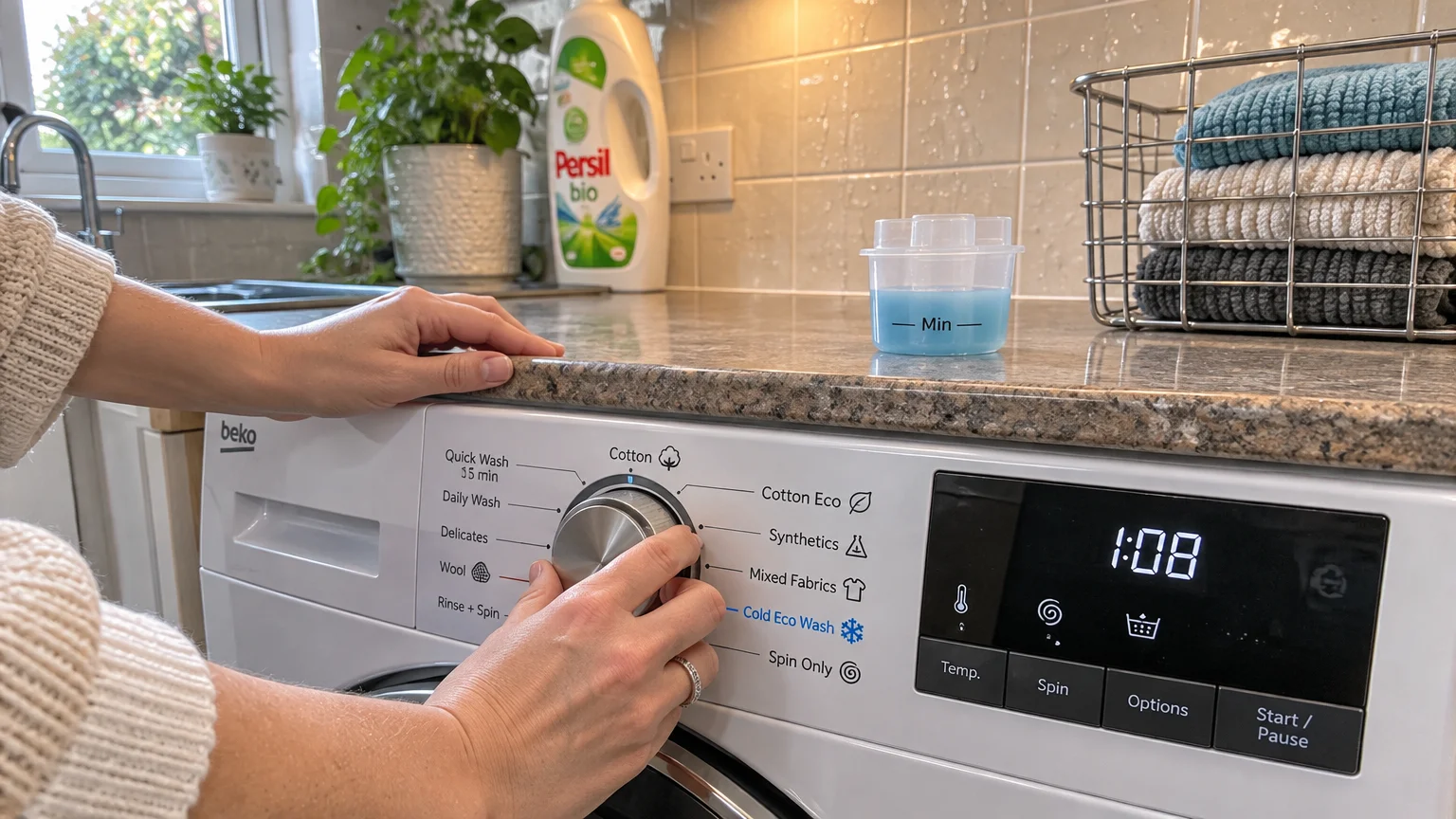
Both ENERGY STAR and Consumer Reports confirm that cold-water cycles clean everyday loads effectively. Dropping your wash temperature is the single fastest way to achieve energy efficient laundry and save money on laundry bills.
Using the August 2026 U.S. Energy Information Administration residential electricity benchmark of 18.16 cents per kWh, Energy Bill Lab data illustrates the gap starkly. A cold wash consumes roughly 0.20 kWh—about $0.036 per load—while a hot wash on an electric water heater draws 2.45 kWh, or $0.445 per load.
Across 300 annual loads, switching from hot to cold saves 675 kWh and roughly $122.58 per year. Households already running mixed temperatures typically save $40 to $80 annually just by shifting everyday loads to cold.
European energy agencies report similar thermal savings. ADEME testing shows washing at 30°C (86°F) uses three times less electricity than a 90°C boil wash and half the energy of a 60°C cycle.
Load Sizing and the Ergonomic Hand-Span Rule
Washing half-empty drums wastes both water and electricity because machines draw nearly the same motor energy regardless of load weight. Running full loads saves more than 3,400 gallons of water per year, according to ENERGY STAR and U.S. DOE estimates.
Avoid packing the drum tightly just to hit a full load, however, because compressed textiles cannot circulate through detergent water. Follow the commercial hand-span check: load dry items loosely until you can slide your open palm vertically between the top of the pile and the drum roof.
If your washer features a deep-fill or bulky setting, reserve it strictly for comforters and waterproof covers. Standard high-efficiency (HE) cycles rely on concentrated detergent slurry and clothes rubbing gently against one another to lift embedded soil.
Understanding Machine Efficiency Ratings and Water Rules
Appliance design dictates your baseline water use far more than cycle selection alone. Older agitator top-loaders consume 30 to 45 gallons per load, whereas standard non-certified modern washers average 20 gallons.
Full-sized ENERGY STAR certified washers drop consumption to 14 gallons per load, using roughly 20% less energy and 30% less water than standard models. Over the appliance’s lifetime, that upgrade saves over 2,000 gallons annually and about $530 in energy costs.
Front-loaders deliver the steepest resource savings among residential styles. EPA WaterSense notes front-loaders use about 25% less energy and water than top-load impeller machines, and ENERGY STAR notes they use roughly 50% less water than traditional agitator top-loaders.
Federal appliance rules are currently in transition, making third-party certification especially useful when shopping. In March 2024, the U.S. DOE finalized updated efficiency metrics—EER and WER—taking effect March 1, 2028, with updated compliance templates posted in June 2026.
However, in May 2025, the DOE proposed rescinding amended residential washer water-use standards to revert to a statutory water factor cap of 9.5 and eliminating compact washer rules, alongside ongoing federal litigation (Word v. Department of Energy, 5th Cir. 2026). Because baseline mandates remain unsettled, choosing an ENERGY STAR model guarantees verified water and energy reductions.
If you live in the United Kingdom or European Union, check the A-to-G energy label introduced in March 2021. Under ENGIE and UK Ecodesign guidelines, that rating measures energy use per 100 cycles on the standardized Eco 40-60 program.
Precision Detergent Dosing and Machine Maintenance
Oversized detergent caps mislead millions of households into doubling or tripling chemical doses. Excess soap does not make clothes cleaner; instead, it creates thick suds that cushion fabric-on-fabric friction and prevent soil from rinsing away.
According to Whirlpool and Appliance Doctors guidelines, concentrated liquid HE detergent requires only 1 tablespoon (15 mL) for an average HE load. Drop that dose to 1 to 2 teaspoons (5 to 10 mL) for small loads, and use 1 to 2 tablespoons (15 to 30 mL) in a standard top-loader.
Increase dosage slightly only when dealing with verified hard water minerals or mud-caked workwear. Keep a dedicated 15 mL stainless steel measuring scoop beside your detergent bottle instead of guessing with the oversized plastic cap.
Skip liquid fabric softeners and dryer sheets on towels, athletic gear, and microfiber cloths. Those products coat fibers in waxy quaternary ammonium compounds that block water absorption and trap gym odors inside synthetic knits.
If you want softer cottons without residue, add 1/2 cup of plain white distilled vinegar to the fabric softener dispenser during the final rinse. The mild acid neutralizes alkaline detergent residue and rinses clean without lingering odor.
Monthly Washer Hygiene Checklist
Cold-water washing and overdosed detergents encourage biofilm—a slimy mix of skin oils, lint, and mold—inside hidden drum troughs and rubber door gaskets. Follow Whirlpool’s maintenance interval to keep your washer smelling fresh and operating efficiently:
- Run a tub-clean cycle monthly: Execute your machine’s self-clean cycle with a dedicated washing machine cleaner or hot water at least once per month, or every 30 wash cycles.
- Ventilate the drum immediately: Leave the washer door ajar and pull the detergent drawer slightly open after every wash so interior humidity evaporates.
- Swab the door boot weekly: Fold back the rubber gasket lip on front-loaders and wipe away trapped hair, coins, and standing gray water with a damp microfiber cloth.
- Scrub the dispenser tray: Remove the detergent drawer once a month and rinse hardened gel buildup under warm tap water with a soft nylon brush.
- Clear the drain pump filter quarterly: Place a shallow baking sheet beneath the lower front access panel, unscrew the coin trap, and clear lint or stray hairpins blocking drainage.
Drying Techniques, Fabric Longevity, and Fire Prevention
High-heat tumbling shrinks natural fibers, cooks faint protein stains permanently into cotton, and wastes electricity when timers overshoot dryness. Remember that running a dryer just 15 extra minutes per load adds up to $34 per year to your power bill, per ENERGY STAR and U.S. DOE data.
Whenever your schedule allows, rack-dry bras, activewear, wool sweaters, and printed tees to avoid tumble damage completely. For daily cotton loads, select the automatic moisture-sensor cycle rather than a 60-minute timed setting so heating elements shut off the moment moisture drops.
Separate heavy bath towels from lightweight synthetics before drying. If they tumble together, thin polyester shirts bake dry for 25 minutes while waiting for thick cotton hems to finish.
When replacing an aging machine, compare heat pump technology against vented units. ENERGY STAR certified dryers use 20% less energy than standard dryers, while certified heat pump dryers use at least 28% less—and up to 50% to 70% less than conventional electric dryers—while operating at fabric-friendly lower temperatures.
Critical Dryer Fire Safety Rules
Lint accumulation turns a routine laundry schedule into a serious home fire hazard. The U.S. Fire Administration (USFA) tracks an estimated 2,900 residential clothes dryer fires every year, causing 5 deaths, 100 injuries, and $35 million in property loss, with incidents peaking in January at 11%.
Broader National Fire Protection Association (NFPA) data—which includes non-confined fires and combination washer-dryers—estimates 14,000 to 15,970 home fires, 13 to 30 deaths, 400 to 444 injuries, and $191 million to $238 million in annual damage, with 92% involving dryers. Both agencies identify failure to clean as the leading contributing factor at 33% to 34% of dryer fires.
Protect your home with four non-negotiable vent and trap habits recommended by USFA, ENERGY STAR, UL Solutions, and NFPA:
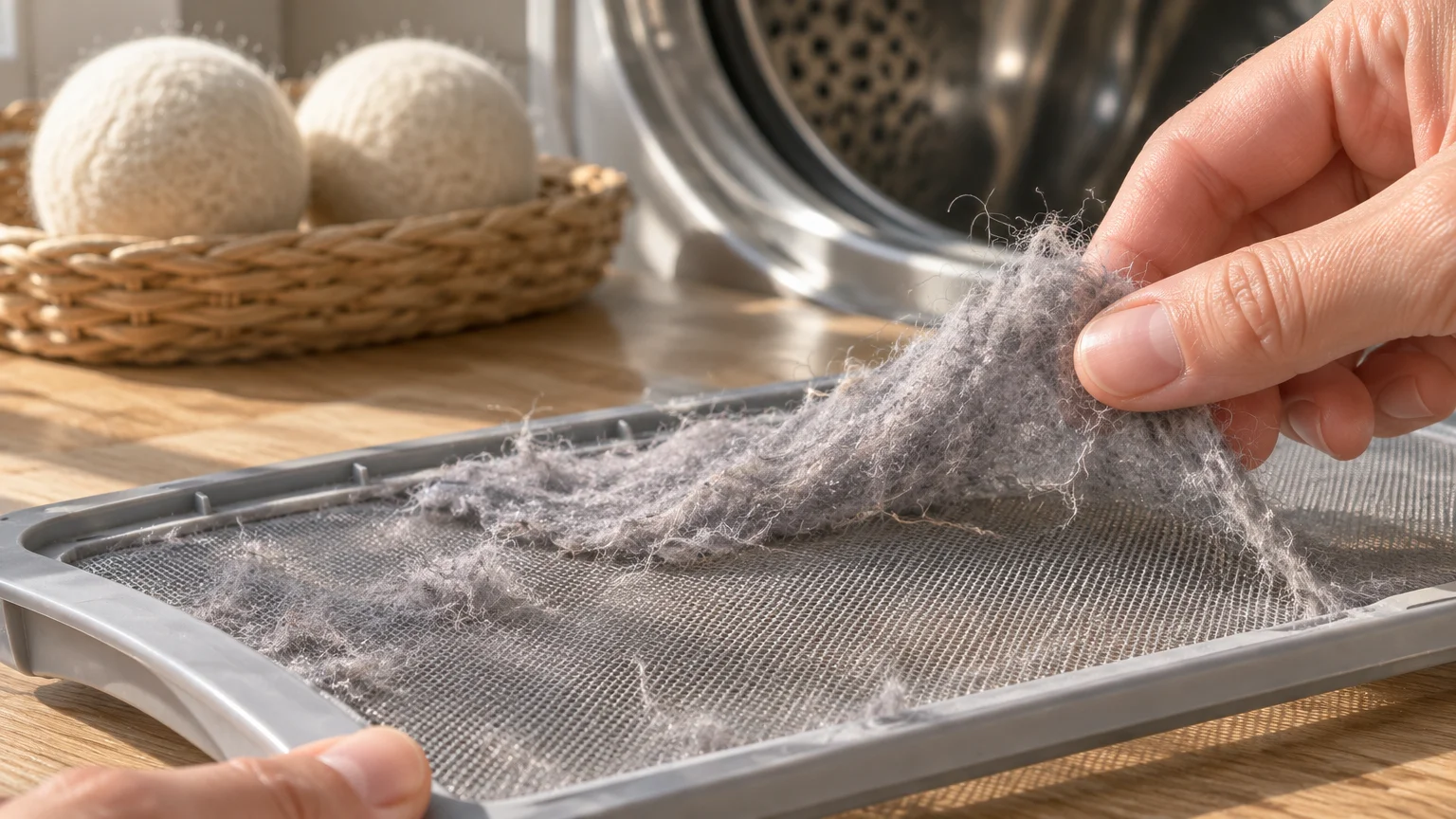
- Clean the lint screen every cycle: Scrape lint from the filter both before starting and immediately after unloading every batch.
- Degrease the screen quarterly: Scrub the mesh lint trap with warm soapy water and a nylon brush every few months to remove invisible wax buildup from dryer sheets or fabric softeners.
- Clear the exhaust duct yearly: Inspect and brush out the full vent run to the exterior wall at least once a year, or every 6 months if you have a large household, pets, or frequent bulky towel and bedding loads.
- Upgrade to rigid metal ducting: Replace crushed plastic or flimsy foil accordion hoses behind the dryer with smooth, rigid metal ducting that resists kinking and contains heat.
An Ergonomic Weekly Laundry Schedule That Runs Itself
Cutting wash frequency works best when paired with an ergonomic sorting station that eliminates marathon weekend folding piles. Place a three-bag rolling sorter at waist height in your bedroom or hallway so clothing lands in the right category the moment you undress.
Older adults and anyone managing back strain benefit enormously from lighter, single-category loads spread across the week. Carrying one crisp basket of shirts creates far less physical strain than hauling a 30-pound mixed mountain up and down basement stairs.
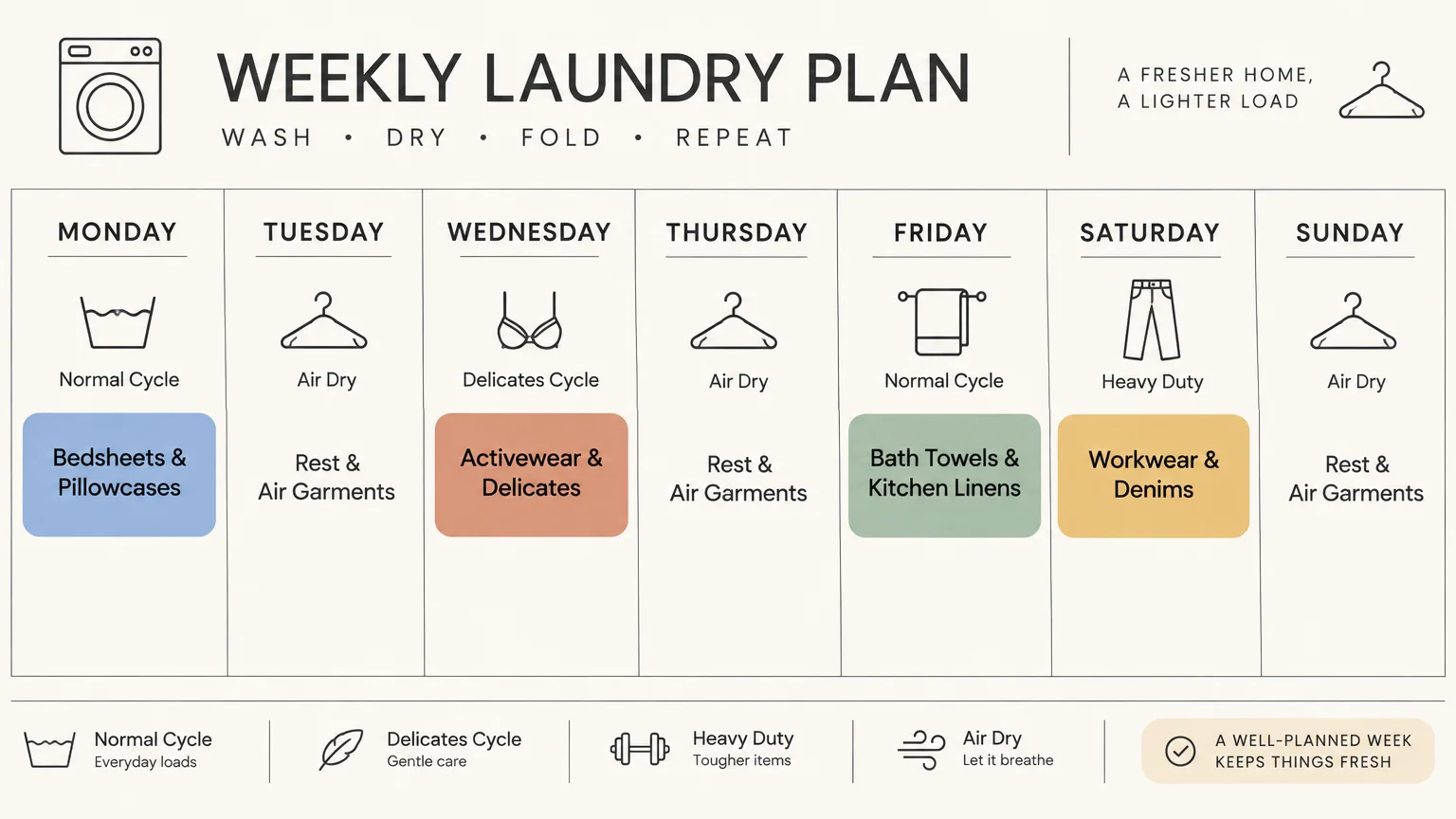
Try this low-effort weekly cadence built around three to four full, purposeful loads rather than daily half-loads:
- Monday (Sheets and Pillowcases): Strip beds in the morning, wash on warm or allergy-hot as needed, and remake beds directly from the dryer so you never fold fitted sheets.
- Wednesday (Bath Towels and Kitchen Linens): Combine bathroom towels with bath mats; run kitchen dish towels separately with hot water or oxygen bleach if heavily soiled.
- Friday (Everyday Cotton Tops and Undergarments): Wash daily-wear T-shirts, socks, and underwear in cold water with 1 tablespoon of HE detergent.
- Saturday or Biweekly (Jeans, Activewear, and Delicates): Run dark denim separately on cold every other week, and wash mesh-bagged activewear on gentle before hanging everything to air-dry.
Spot-treat collar rings, coffee drips, and grease marks the evening you take the garment off using an enzyme pre-treater, letting it sit at least 10 minutes before washing. Prompt spot treatment lets jeans, sweaters, and outerwear reach their full three-to-four-wear lifespan without staining.
Your immediate next step takes five minutes today: grab a roll of masking tape and a marker, label your detergent scoop at the 1-tablespoon mark, and clear your dryer lint trap and exterior vent flap before starting your next load.