You do not need harsh chemical foggers to protect your home from roaches. Effective cockroach prevention relies on targeted dry dusts, surface-chemistry sprays, and tight moisture control that disrupt insect biology at the source.
Commercial cleaners and pest specialists pair simple household ingredients with strict crack sealing for lasting natural pest control. When you apply each remedy correctly, you eliminate hiding spots without filling your living space with lingering fumes.
Below, you will find seven proven roach home remedies, the exact science behind how each works, and the safety rules that keep your family and pets protected.
Why Cockroaches Invade Clean Homes and Trigger Indoor Allergies
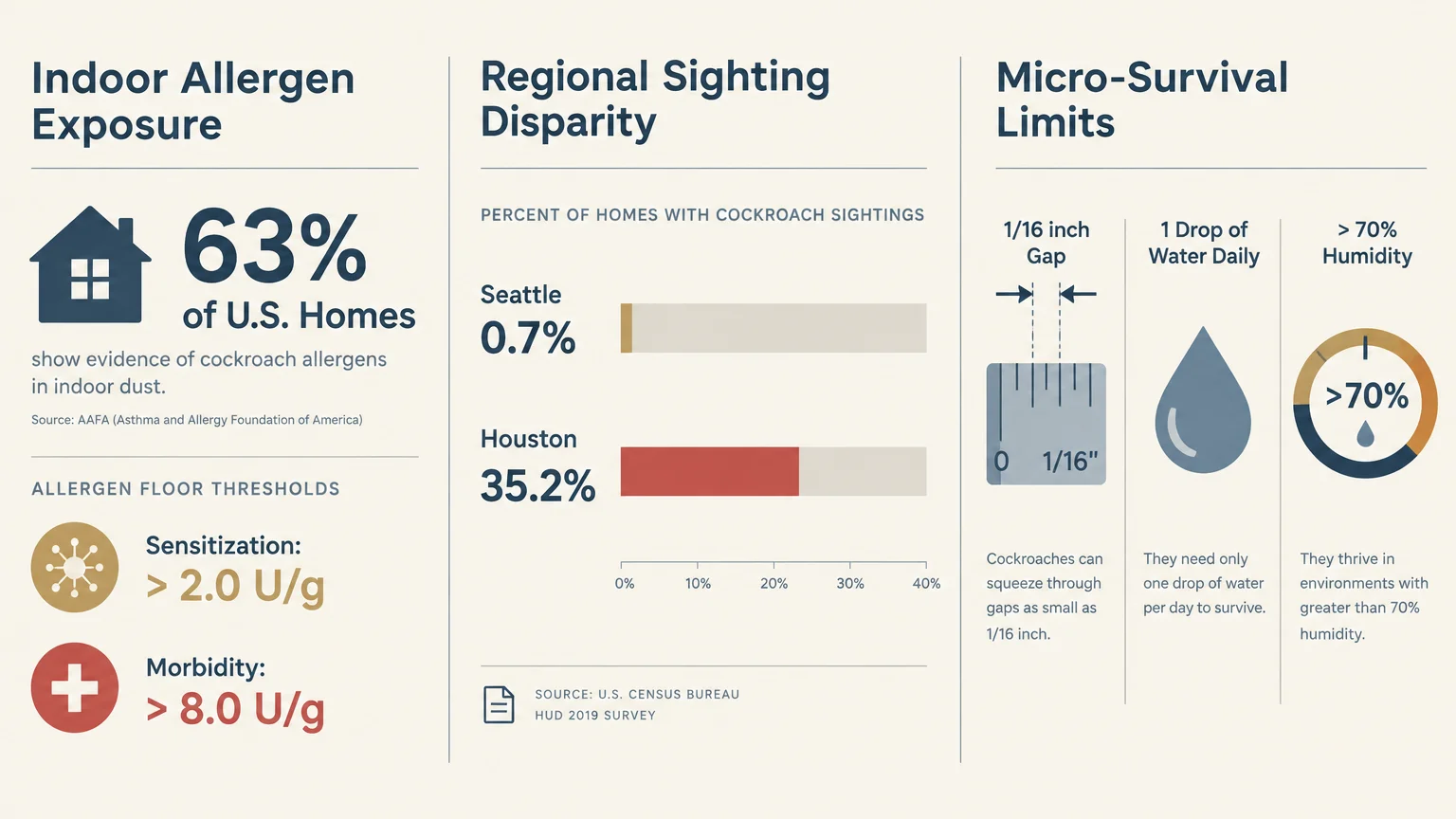
Spotting a roach in your kitchen does not mean you keep a dirty house. According to the U.S. Census Bureau and HUD 2019 American Housing Survey, residents in 14 million of roughly 124 million U.S. homes—about 11.3%—reported cockroach sightings within a year.
Sightings climb sharply in renter-occupied units, southern climates, and homes near trash areas or water leaks. Across major metro regions, reported sightings ranged from 0.7% in Seattle to 35.2% in Houston.
Even a small infestation quickly becomes an indoor air-quality hazard. The U.S. Environmental Protection Agency (EPA) notes that Americans spend up to 90% of their time indoors, where pest debris triggers respiratory flare-ups.
Data from the Asthma and Allergy Foundation of America (AAFA) shows that 60–70% of people with asthma have allergic asthma, and cockroach allergens appear in 63% of U.S. homes.
A national NIH-archived study of 831 homes found cockroach allergen exceeded sensitization levels of 2.0 U/g on 11% of living room floors and 13% of kitchen floors. Kitchen floors in 10% of those homes exceeded the 8.0 U/g threshold linked to asthma morbidity.
These pests survive on almost nothing inside warm, humid rooms. German and American cockroaches thrive between 77°F and 91°F when relative humidity stays above 70%, and they need only a single drop of water daily.
When food crumbs vanish, roaches readily eat soap residue, shed hair, and toothpaste smears. German cockroaches squeeze through gaps just 1/16 inch wide, molt six times while shedding allergenic skins, and multiply rapidly.
Research compiled by the California Childcare Health Program and UC Integrated Pest Management (UC IPM) warns that one female and her offspring can produce 30,000 roaches in a single year. If you see roaches during daylight hours, a large hidden population already occupies your walls.
01 Food-Grade Diatomaceous Earth for Long-Lasting Dry Barriers
Food-grade diatomaceous earth (DE) gives you a non-toxic mechanical barrier that works around appliances and baseboards. This chalky powder consists of fossilized microscopic algae with razor-sharp edges at the cellular level.
As a roach walks across DE, the fine powder absorbs protective waxy lipids from its outer cuticle and abrades its exoskeleton. The insect loses internal moisture rapidly and dies from dehydration.
You must buy product labeled strictly as food-grade DE for indoor diy pest control. Pool-grade DE undergoes high-heat treatment that leaves over 60% crystalline silica, creating a severe lung toxin for humans and pets.
The National Pesticide Information Center (NPIC) notes that food-grade DE carries minimal crystalline silica and is registered as a cockroach pesticide. Even so, proper tool selection determines whether roaches cross it or walk right around it.
Professional Application Rules for Diatomaceous Earth
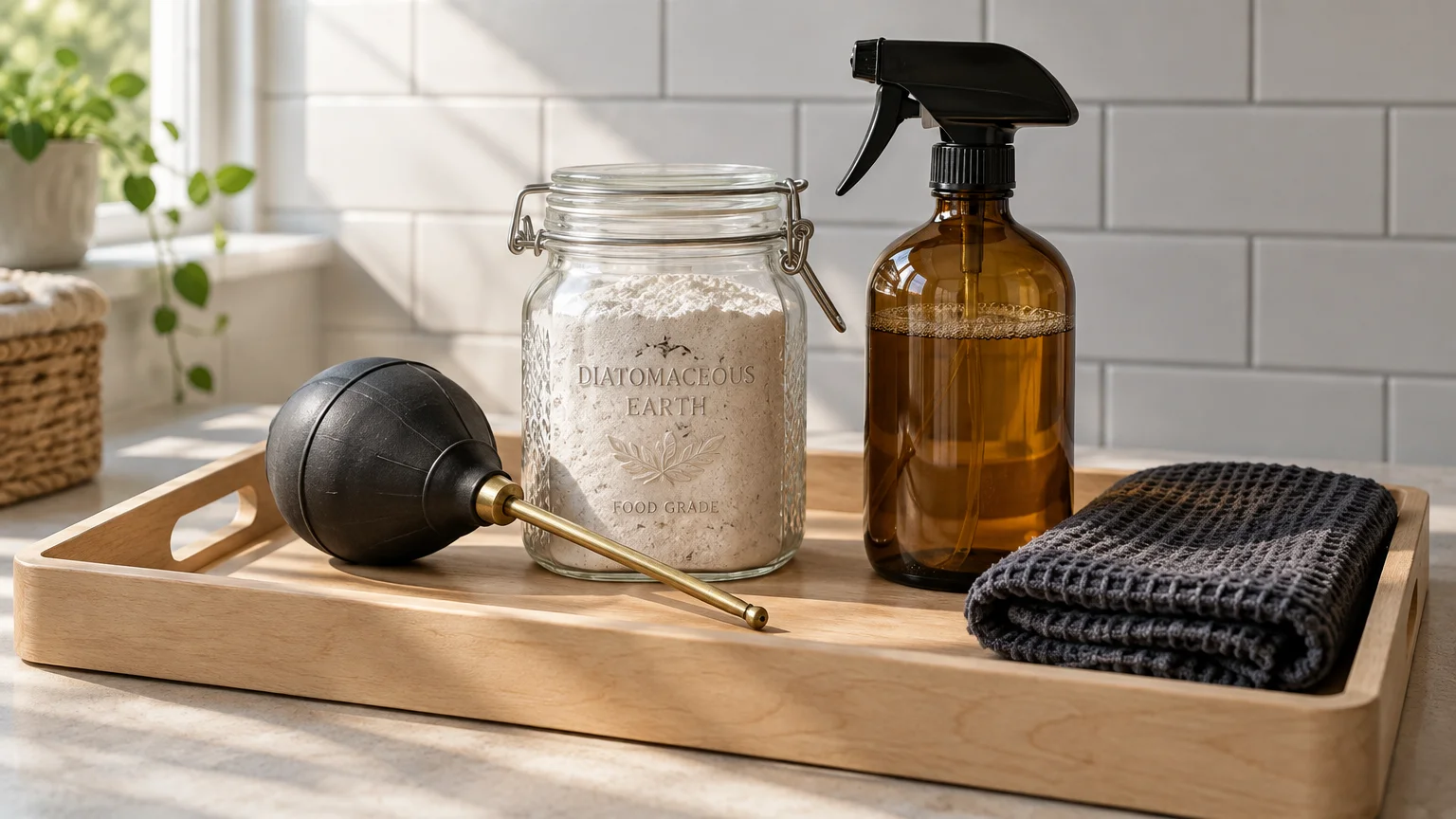
Skip spooning thick white mounds along your baseboards, because roaches sense tall piles and detour around them. Instead, load a handheld rubber-bulb duster or bellows applicator to puff a barely visible film along travel edges.
- Prep the surface first: Vacuum corners with a HEPA-filtered crevice nozzle, then wipe away cooking grease and let the surface dry completely before dusting.
- Dust tight voids: Puff thin coats beneath your refrigerator kickplate, behind your stove, inside electrical outlet bezels, and along cabinet toe-kicks.
- Keep it bone-dry: Moisture causes DE to clump and lose its dehydrating power, so never dust damp bathroom tile or near active pipe drips.
- Protect your airways: Wear an N95 dust mask and safety glasses while applying powder, since airborne DE irritates eyes, nasal passages, and lungs.
- Respect the timeline: Individual insects begin dying within 4 to 24+ hours, with visible reductions around 48 hours, though full control takes 2–4 weeks because DE does not destroy eggs.
Vacuum up clumped powder once a week with a HEPA vacuum and refresh the dry film until sticky monitors stay empty. Keep pets out of treated rooms until airborne dust settles completely.
02 Boric Acid Dust for Hidden Wall and Appliance Voids
If you want to get rid of cockroaches naturally in deep structural voids, mineral-derived boric acid outperforms most household sprays. Boric acid was first registered in the U.S. in 1948 and reregistered by the EPA in 1993.
Its close cousin, sodium tetraborate decahydrate—commonly sold in laundry aisles as borax—works through the same dual mechanism. Fine particles cling to a roach’s legs and antennae, and the insect ingests the mineral while grooming itself.
Virginia Tech Extension rates boric acid dust highly effective when paired with thorough sanitation. However, moisture and kitchen grease sharply reduce its performance, coating the powder so it no longer sticks to passing insects.
Before dusting, scrub cabinet hinges and stove sides with an alkaline degreasing spray and a tight-weave split-fiber microfiber cloth. Allow wood, laminate, or painted drywall to dry fully so the dust stays fluffy and active.
Critical Safety Boundaries Around Pets and Children
Natural origin does not make boric acid harmless inside a family home. NPIC annual reports from 2021 and 2022 rank boric acid among the top three pesticide ingredients involved in animal exposure incidents.
Roughly 76%–81% of documented pesticide accidents happen inside the home or yard, and poisoning signs in pets can start within 2 hours of ingestion. Never sprinkle boric acid or borax openly across pantry shelves, countertops, or floors where pets walk.
- Target inaccessible cavities: Blow a light dusting only behind wall plates, inside plumbing escutcheon gaps, and deep under heavy appliances you must slide out to reach.
- Avoid wet mopping zones: Keep powder several inches back from baseboards you mop regularly, preventing slurry streaks that attract curious dogs or cats.
- Use a precision applicator: A narrow-tip squeeze duster prevents messy spills and delivers thin layers that remain effective for months when kept dry.
03 Baking Soda and Sugar Baits for Quick Internal Action
Plain pantry baking soda offers a simple internal kill mechanism when roaches ingest it alongside a sweet attractant. Sodium bicarbonate reacts with digestive moisture and stomach acids inside the insect to produce carbon dioxide gas.
Because cockroaches cannot release built-up gas efficiently, internal pressure ruptures their digestive tract within 24–48 hours. A laboratory trial at Cebu Doctors’ University found a baking soda and sugar blend killed American cockroaches at speeds matching boric acid.
Another 2013 study tested pellets combining 3 parts boric acid to 1 part baking soda and recorded an average kill time of 5 hours. Still, real-world kitchen results require smart placement and fresh moisture management.
Many German cockroach populations have evolved an inherited genetic aversion to glucose and simple sugars after decades of exposure to commercial gel baits. If your roaches ignore plain white sugar, swap the attractant for finely crushed dry oatmeal or a smear of peanut butter.
How to Build Spill-Proof Baking Soda Bait Trays
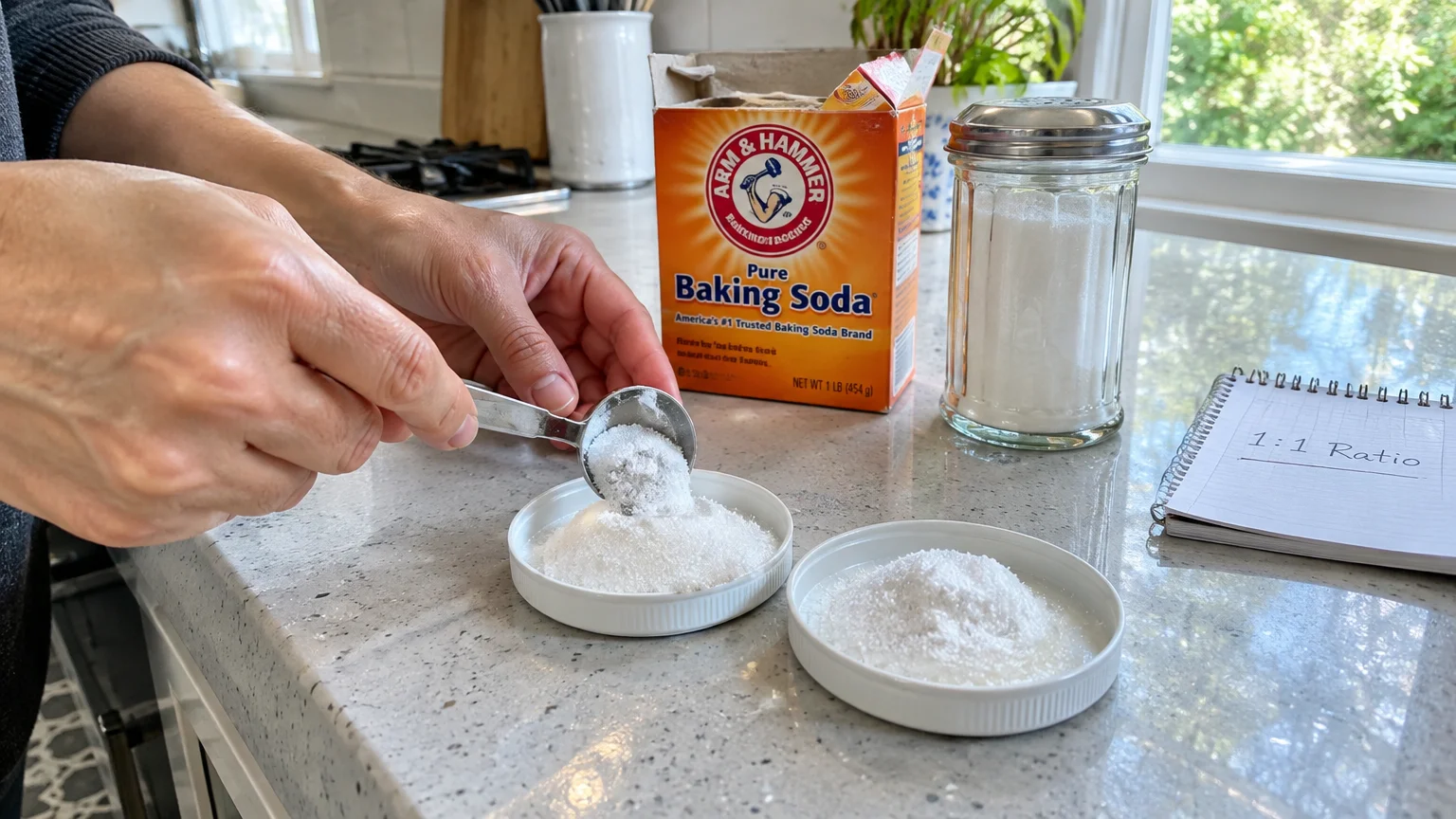
Never pour loose sugar and baking soda straight onto cabinet liners, because humidity turns sugar sticky and draws ants. Build contained, disposable stations using shallow jar lids or folded cardstock trays.
- Mix dry ingredients evenly: Stir equal parts baking soda and powdered sugar—or finely ground oats if sugar fails—in a dry disposable cup.
- Load shallow lids: Spoon a thin layer into clean metal jar lids so roaches can climb easily over the low rim.
- Pair with controlled hydration: Because baking soda needs moisture to react internally, place a separate damp cotton ball in a bottle cap nearby if the room is completely dry, while keeping all sink leaks fixed.
- Slide stations out of reach: Tuck lids inside child-locked under-sink trays, behind trash bins, and inside high utility closets every evening.
- Refresh weekly: Discard hardened or clumped bait every seven days and wipe surrounding surfaces clean with a damp microfiber cloth.
04 Peppermint Essential Oil for Temporary Perimeter Repellency
Pure peppermint essential oil works well as a fast scent barrier around doorways and window tracks. A Texas A&M University evaluation on American cockroaches found peppermint oil delivered the strongest botanical repellency, ranking behind only synthetic insecticide sprays.
By contrast, lavender and orange oils performed poorly in the same trial and barely deterred foraging insects. Understand the practical limit here: peppermint oil drives roaches away from treated trim rather than wiping out hidden nests.
Under federal rule 40 CFR 152.25(f), qualifying botanicals such as peppermint, rosemary, thyme, garlic, and geraniol qualify as minimum risk pesticides. That exemption means the EPA does not test or verify their effectiveness before stores sell them.
Manufacturers also cannot legally claim exempted oils control public-health pests like disease-carrying cockroaches without full registration. Treat peppermint sprays strictly as a perimeter deterrent alongside physical exclusion and dry dusts.
Pet Toxicity Rules You Cannot Ignore
If you share your home with cats or dogs, exercise extreme caution with concentrated botanical oils. Consumer blends often contain 1% to 20% oil, while pure dropper bottles reach 100% concentration.
Guidance from the ASPCA Animal Poison Control Center, Pet Poison Helpline, and the San Francisco SPCA warns that peppermint, tea tree, eucalyptus, citrus, cinnamon, clove, pine, wintergreen, sweet birch, pennyroyal, and ylang ylang oils can poison pets.
Cats lack the UGT1A6 liver enzyme needed to break down phenolic compounds safely. As few as 7–8 drops of concentrated tea tree oil can trigger severe poisoning in a cat.
- Choose safe zones: Only mist diluted peppermint spray—roughly a dozen drops in a spray bottle of water with a drop of mild liquid soap to emulsify—along exterior door thresholds and utility room entry points pets cannot lick.
- Protect finished wood: Essential oils can soften varnish, lacquer, and polyurethane floor finishes, so blot overspray promptly with a dry cloth.
- Skip indoor diffusers: Airborne oil droplets settle onto pet fur, where animals ingest concentrated residue during routine grooming.
05 Dish Soap and Water Spray for Immediate Contact Control
When a stray roach darts across your kitchen counter, a bottle of soapy water stops it faster and cleaner than aerosol cans. Peer-reviewed research published in the Journal of Economic Entomology in April 2002 confirmed that diluted household dishwashing liquid kills German cockroaches on direct contact.
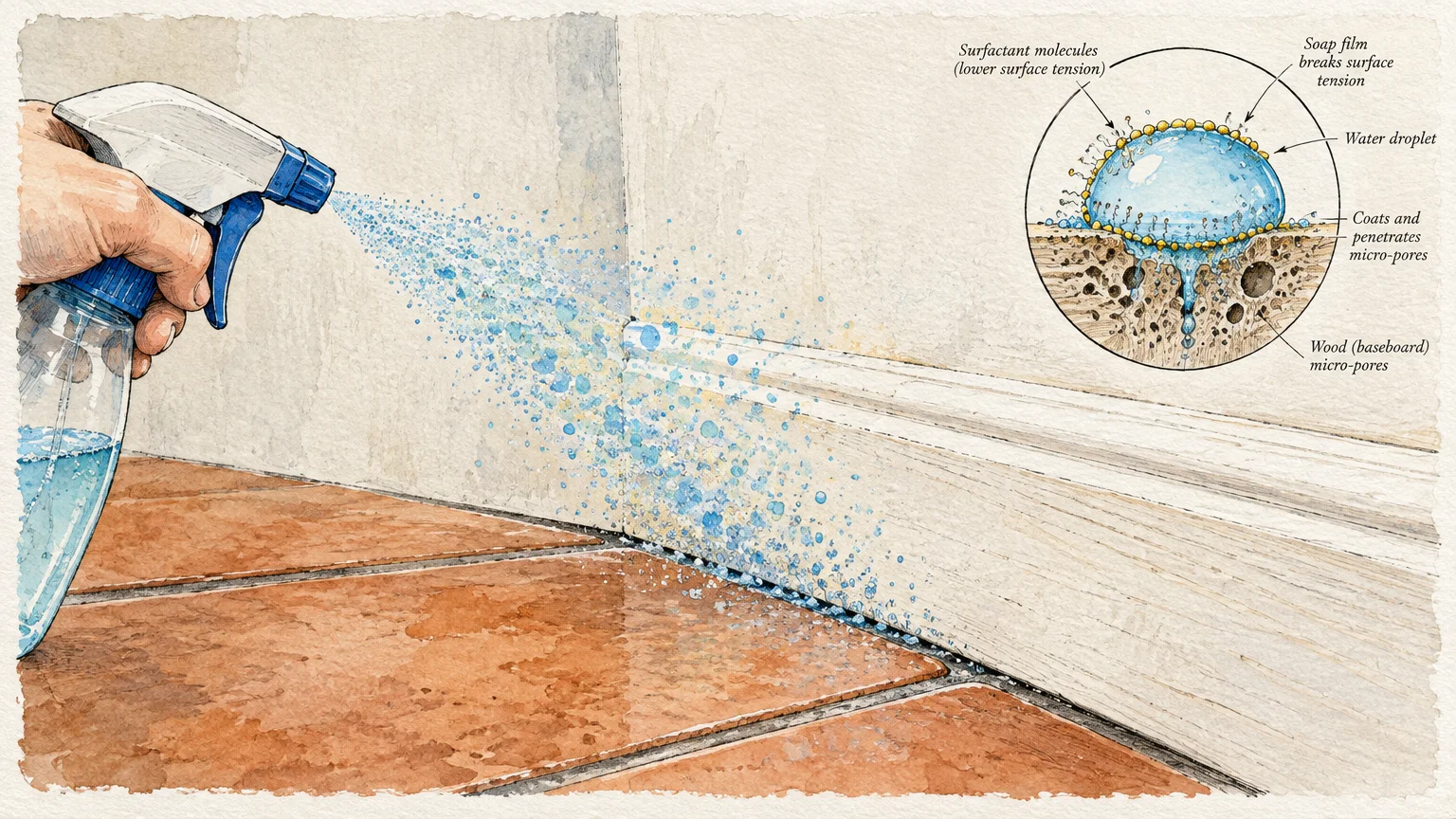
Plain water beads harmlessly off a cockroach’s waxy shell, but dish detergent breaks water surface tension instantly. The thin film floods and seals the insect’s spiracles—the tiny breathing openings along its sides—causing rapid suffocation.
Concentration matters more than most DIY guides mention. Overly weak mixtures fail to break surface tension well enough to block spiracles, allowing soaked roaches to crawl away and recover.
Mix enough liquid dish soap into lukewarm water to feel slightly slick between your fingers—about two tablespoons per quart—and store it in a labeled trigger sprayer set to a tight stream rather than a fine mist. Conventional synthetic dish detergents differ legally from EPA-exempt insecticidal soaps, which rely on potassium salts of fatty acids capped at 1% or less.
Treat soapy water strictly as an on-demand knockdown tool rather than a preventative coating. Once the liquid dries on your floor, it leaves zero residual barrier against roaches emerging from walls overnight.
Always wipe soapy puddles immediately from hardwood, laminate, or unsealed tile to prevent slip hazards—an essential habit for older adults keeping floors safe. Use a dry waffle-weave microfiber towel to buff floors completely dry after cleanup.
06 White Vinegar and Enzyme Solutions to Erase Scent Trails
Cockroaches leave chemical pheromone markers in their droppings and body oils that guide other roaches straight to food and shelter. Distilled white vinegar mixed with equal parts water cuts through light kitchen film and neutralizes those invisible scent trails.
Be realistic about what vinegar accomplishes in natural pest control: it does not kill adult roaches or destroy egg cases. Its real strength lies in disrupting navigation highways during your nightly kitchen reset.
Use an enzymatic cleaner first on heavy grease buildup, pet food residue, or sticky trash spills inside cabinet corners. Enzyme formulas break down organic proteins and starches at the microscopic level, removing the microscopic food trace roaches smell from feet away.
Follow up with your vinegar-water spray on safe non-porous surfaces using a flat microfiber pad or tight-weave cloth. Fold your cloth into quarters so you flip to a clean face for every new zone instead of smearing pheromones across countertops.
Material Compatibility Warnings for Acidic Cleaners
Never spray white vinegar onto natural stone countertops, travertine backsplashes, marble vanity tops, or unsealed granite. Acetic acid etches calcium-based stone on contact, leaving dull rings that require professional honing to fix.
- Safe vinegar surfaces: Sealed laminate, stainless steel, glazed ceramic tile, glass, and sealed porcelain wipe clean safely with diluted vinegar.
- Avoid stone and waxed wood: Use pH-neutral dish soap or stone-safe enzyme cleaners on marble, limestone, soapstone, and waxed hardwood floors.
- Scrub textured grout: Pair pH-neutral cleaner with a stiff-bristle nylon grout brush around sink rims, where toothpaste smears and soap scum feed wandering nymphs.
07 Bay Leaves and What Actually Works Inside Pantry Cabinets
Tucking dried bay leaves into flour canisters and silverware drawers remains one of the oldest pantry myths in home care. Practical pest evaluations from Anticimex Carolinas and MMPC Pest Solutions confirm that scattered whole or crushed bay leaves offer only a mild, temporary odor deterrent.
Laboratory testing shows only concentrated, distilled bay-leaf essential oil applied directly onto an insect displays real killing ability—dried kitchen leaves never eliminate an active infestation. Relying on loose leaves inside open cereal boxes often masks a growing problem until droppings appear.
You can still use bay leaves productively if you combine their mild scent with airtight physical exclusion. Start by emptying your pantry shelf by shelf and inspecting corrugated shipping cartons, which frequently hide tiny egg cases inside glued flutes.
Transfer all dry goods—flour, pasta, oats, rice, crackers, and pet kibble—out of thin paper boxes and into rigid glass or BPA-free plastic canisters with silicone gasket lids. Wipe bare shelves with warm soapy water, dry them thoroughly, and place sealed muslin sachets of crushed bay leaves strictly as a mild fresh-scent backup.
For older adults simplifying kitchen upkeep, clear gasket-sealed bins also reduce heavy lifting and let you spot pantry spills with a quick glance. Vacuum shelf edges monthly with a soft dusting brush attachment so crumbs never collect along rear wall seams.
How the 7 Home Remedies Compare on Speed, Safety, and Limits
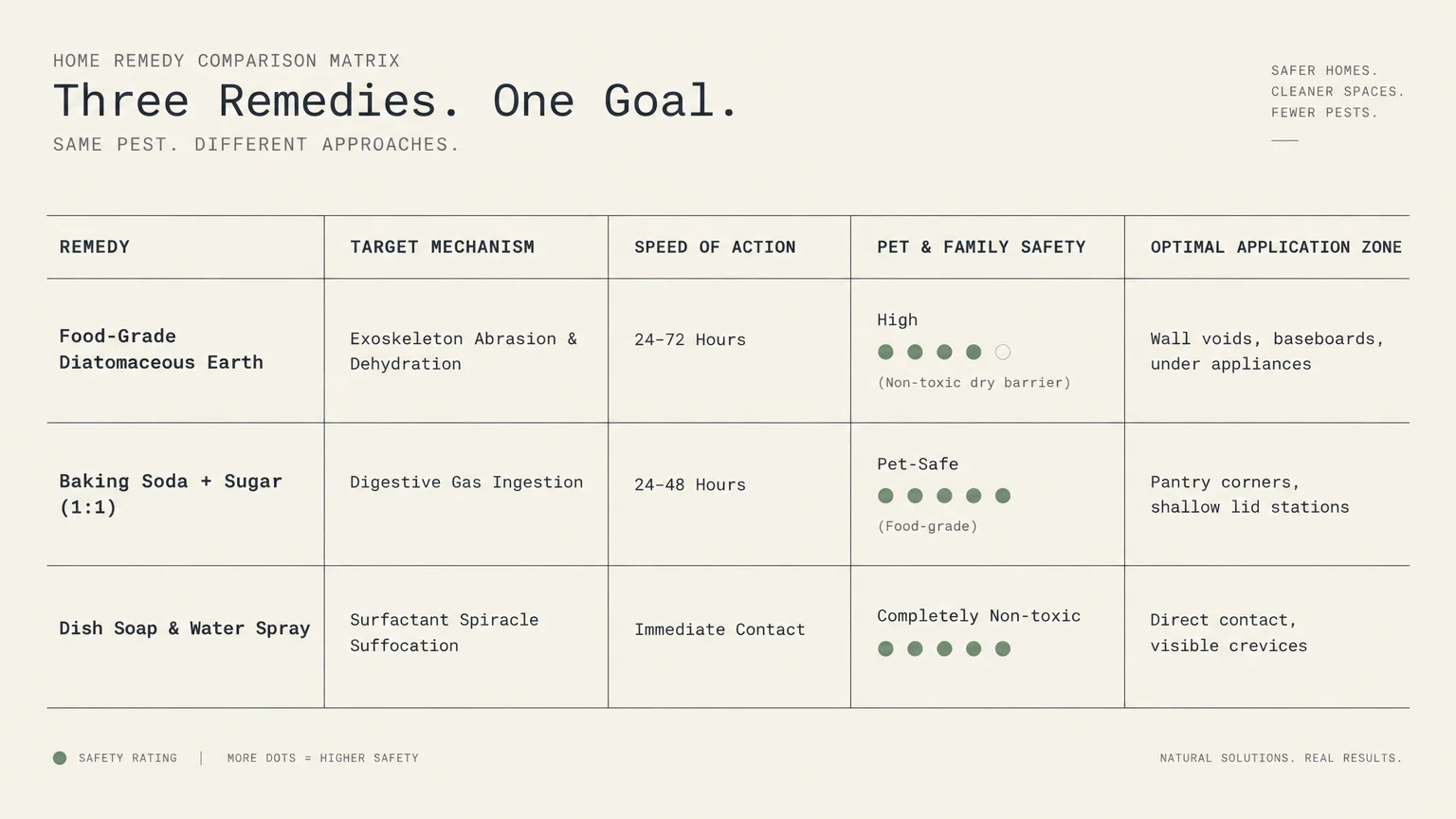
Pairing the right remedy with the right location saves hours of wasted scrubbing. Use this reference table to match each natural option to your specific room, surface material, and household safety needs.
| Remedy | How It Works | Timeline | Safety and Material Notes | Best Placement |
|---|---|---|---|---|
| Food-grade diatomaceous earth | Absorbs cuticle wax and dehydrates roaches | Starts in 4–24+ hours; full control in 2–4 weeks | Wear dust mask; avoid pool-grade DE (>60% silica); keep dry | Dry wall voids, under stove, behind fridge |
| Boric acid or borax | Internal stomach poison picked up while grooming | Hours to days depending on grooming contact | Toxic to pets within 2 hours; keep away from moisture and grease | Deep inaccessible cracks, plumbing voids |
| Baking soda and sugar | Releases fatal carbon dioxide gas in gut | 24–48 hours (5 hours with boric acid pellets) | Low hazard; glucose-averse roaches may avoid sugar | Contained jar-lid trays in locked cabinets |
| Peppermint essential oil | Strong botanical scent repels foraging insects | Immediate, short-lived deterrence | Toxic to cats and dogs; may soften wood finishes | Exterior door thresholds away from pets |
| Dish soap and water spray | Breaks surface tension and blocks breathing spiracles | Seconds to minutes on direct contact | No residual effect; wipe floors dry to prevent slips | Direct spray on exposed roaches |
| White vinegar solution | Dissolves grease and masks pheromone trails | Immediate surface reset; does not kill roaches | Etches marble, granite, and natural stone | Sealed counters, stainless appliances, trash cans |
| Dried bay leaves | Mild aromatic deterrent only | Temporary odor masking; does not kill | Safe in sealed sachets; not a standalone fix | Inside airtight, gasket-sealed pantry shelves |
Professional Prevention Rules That Make Home Remedies Work
Even the sharpest dust or best bait fails if water drips under your sink and cardboard piles sit beside your refrigerator. Organizations including the EPA, Texas A&M School IPM, and the California Childcare Health Program all stress Integrated Pest Management (IPM) ahead of any chemical treatment.
IPM also warns strongly against over-the-counter foggers, bug bombs, and broad perimeter sprays. Broadcast sprays kill only exposed insects, miss deep wall nests and egg cases, underperform targeted baits, and leave toxic residues across dishes and floors.
Follow this streamlined weekly workflow to strip away food, water, and shelter while letting your dry remedies work at peak strength.
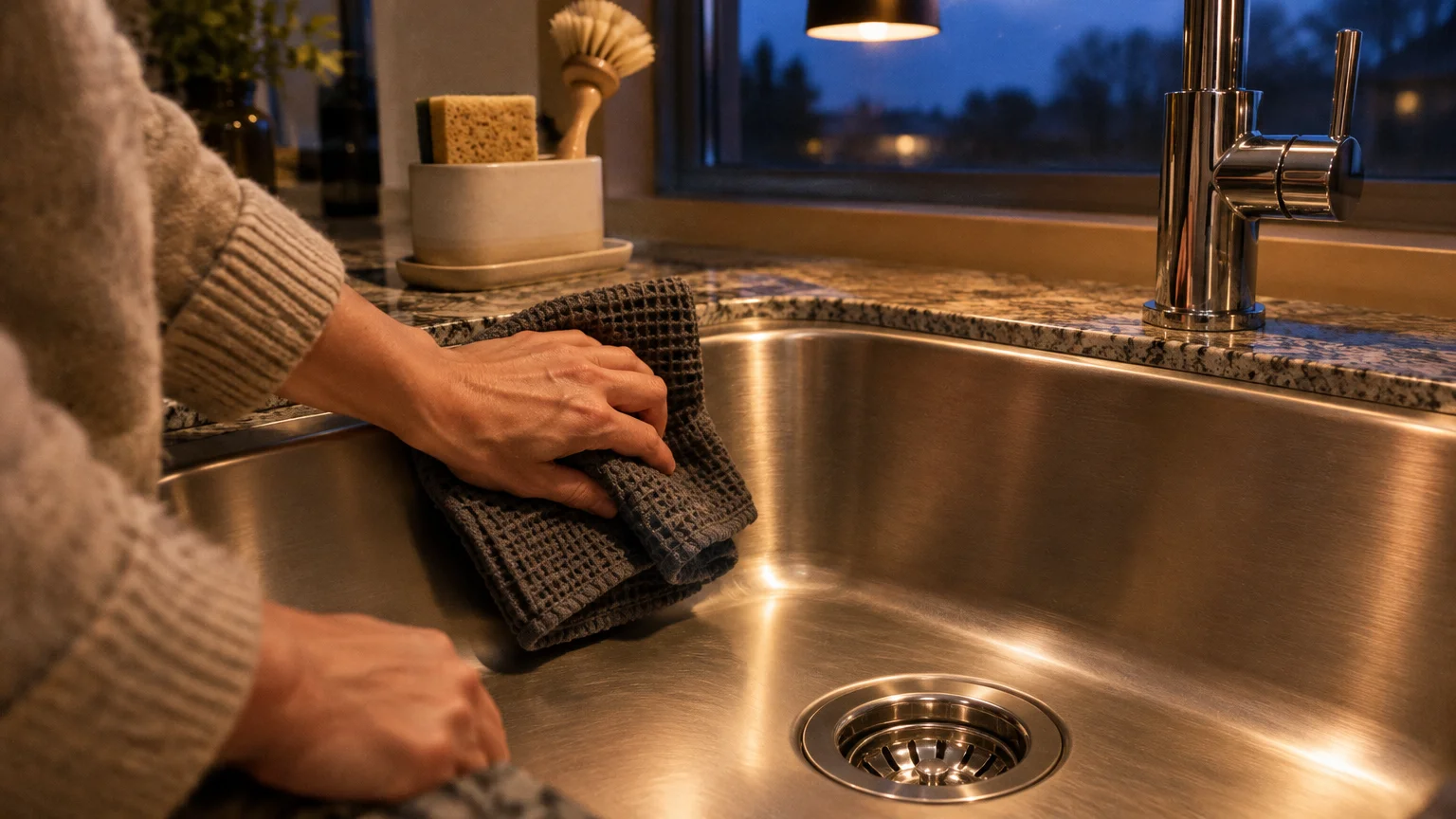
- Cut off the single-drop water supply: Tighten dripping P-traps, replace worn faucet washers, dry sink basins with a dedicated microfiber cloth before bed, and empty pet water bowls overnight.
- Seal 1/16-inch entry highways: Apply paintable acrylic latex or 100% silicone caulk along backsplash seams, cabinet gaps, and pipe collars, and install foam gaskets behind kitchen outlet covers.
- Ban cardboard storage: Unpack delivery boxes outside your door, recycle flattened cartons immediately, and store pantry supplies or garage items in smooth-sided plastic totes.
- Clear hidden organic fuel: Scrub sink drains weekly with a stiff nylon bottle brush and enzyme drain cleaner, and vacuum toaster crumbs and refrigerator condenser dust once a month.
- Deploy sticky monitoring traps: Slide flat glue monitors tight against walls behind your fridge, under the sink, and near water heaters to track activity and confirm which zones still need dry dusting.
Check your glue monitors every seven days rather than guessing whether treatments worked. If sticky traps catch fewer nymphs each week, your barrier dusts and moisture controls are breaking the breeding cycle.
When daytime sightings continue after four weeks of strict dry dusting, sealing, and sanitation, contact a licensed IPM pest professional. Persistent multi-unit infestations in apartments often travel through shared plumbing chases that require building-wide coordination.
Your First Step Tonight
Walk your kitchen and bathrooms with a bright flashlight for five minutes right after dinner. Look under sink pipes for moisture, pull out any loose cardboard boxes, wipe sink basins completely dry, and set two sticky monitors flat along the wall beside your stove and refrigerator so tomorrow morning tells you exactly where to apply your first barrier.