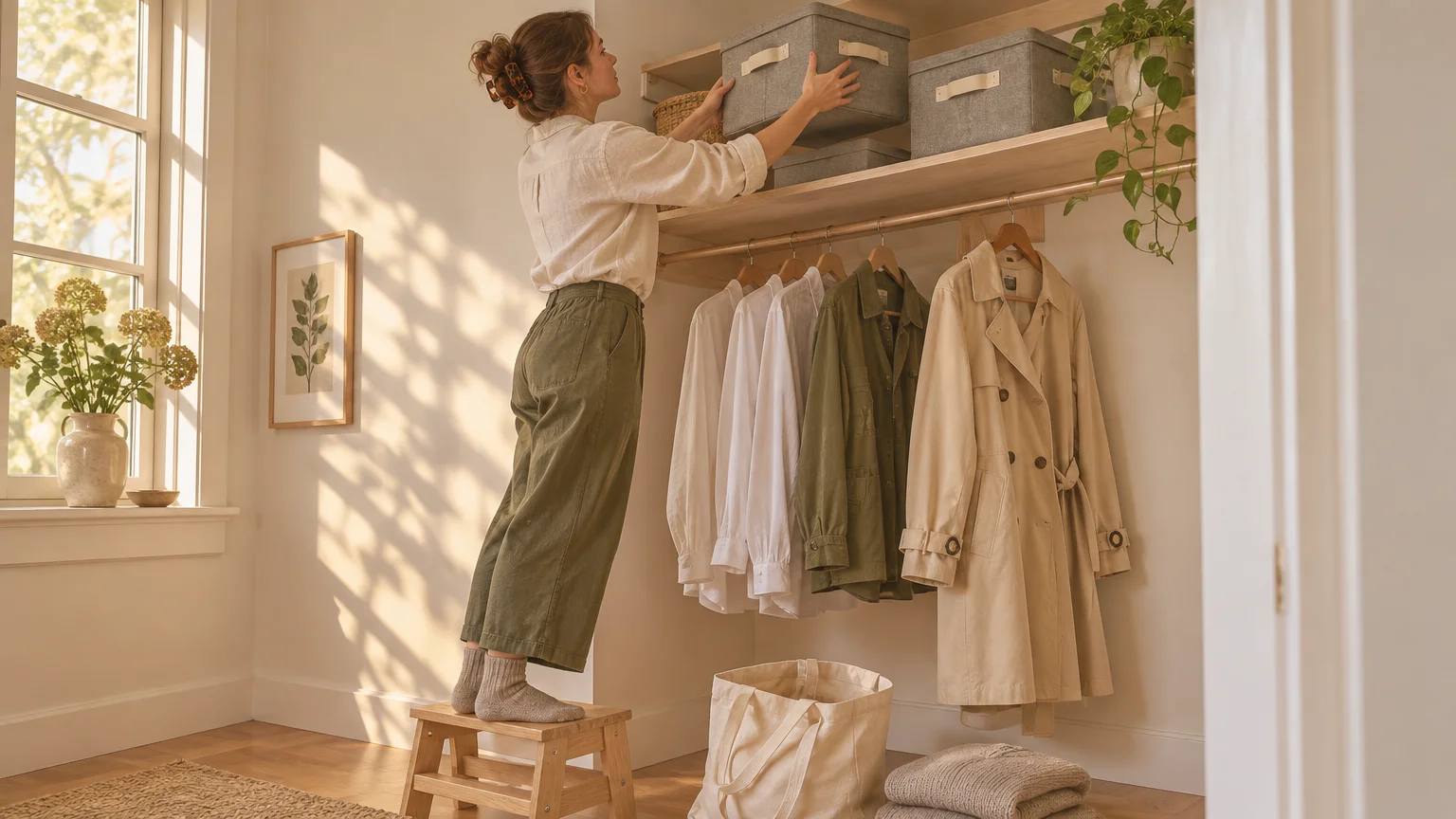
Clearing bulky coats or summer dresses out of your daily closet turns morning dressing into a calm, fast routine. Using smart methods to store out-of-season clothes frees up prime shelf space and keeps fabrics fresh until next year.
A 2022 UK survey by WRAP found the average adult owns 118 clothing items, with 26%—about 31 pieces—unworn for at least a year. Moving seasonal garments out of the way lets you see and wear what fits right now.
You do not need expensive matching containers to upgrade your closet organization. These seven practical clothing storage tips, container guidelines, and prep steps protect every piece in your seasonal wardrobe.
Sort, Clean, and Check Your Climate Before Packing Clothes
Packing away everything you own just moves clutter from your closet rod into hidden bins. Before you box up a single sweater, pare down your seasonal wardrobe so you only store pieces you genuinely want to wear again.
According to a 2022 OnePoll and Stitch Fix UK survey of 2,000 adults, 59% left clothes unworn because items sat buried at the back of closets or drawers. Another 65% still owned unworn pieces with tags attached, while 20% kept clothes that no longer fit.
Global clothing utilization dropped roughly 36% to 40% over 15 years while production doubled, according to the Ellen MacArthur Foundation. In the United States, garments get worn for only about 25% of the global average, with some items discarded after just 7 to 10 wears.
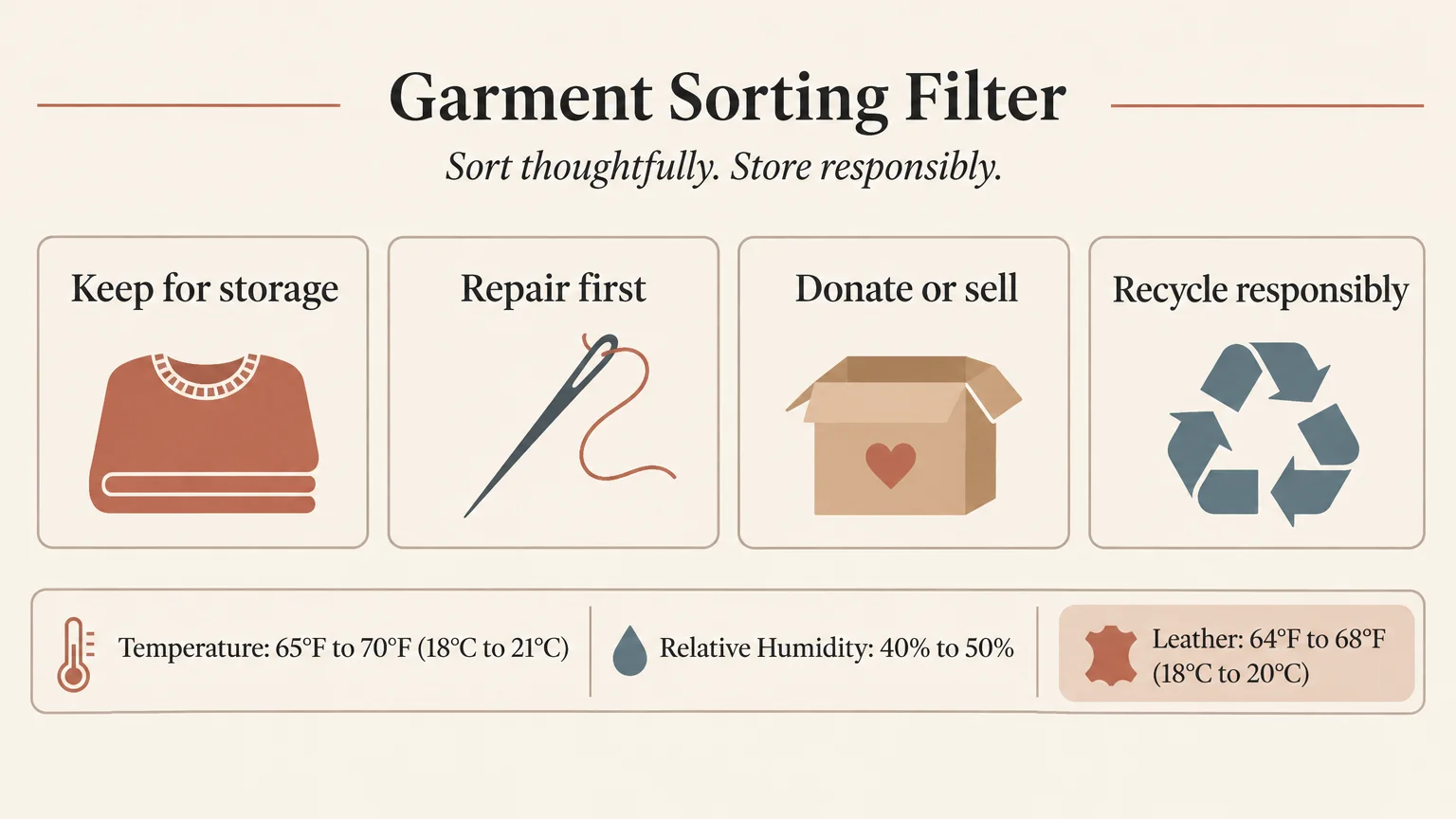
Use this quick four-step sorting filter before any garment goes into off-season storage:
- Keep for storage: Items that fit comfortably today, feel good on your skin, and match your current lifestyle.
- Repair first: Pieces missing a button or needing a quick hem go into a small mending basket with a set deadline, never into a sealed bin.
- Donate or sell: Clean garments in good condition that no longer fit your body, climate, or daily routine.
- Recycle responsibly: Stained, torn, or stretched-out items that cannot be repaired or worn by someone else.
Once you finalize your keep pile, wash or dry-clean every single item before packing. The Smithsonian Institution advises storing textiles completely clean—and unironed, unstarched, and unblued for washable fabrics—because grit cuts fibers and residue feeds mildew.
Even invisible spots attract trouble while clothes sit unattended for six months. The University of California Statewide IPM Program (UC IPM) notes that fabrics stained with food, perspiration, or urine are far more vulnerable to clothes moth larvae damage.
Let every garment dry completely before sealing a lid or zipping a bag. Both the Smithsonian Institution and the Canadian Conservation Institute (CCI) warn that trapped moisture causes condensation and mildew inside closed containers.
Finally, skip the attic, basement, and garage when picking a storage spot. Both the Smithsonian Institution and the Library of Congress advise against those zones because temperature swings, leaks, and humidity spikes wreck fabrics inside sealed bins.
Aim for a dark interior closet or spare bedroom shelf kept at 65°F to 70°F (18°C to 21°C) and 40% to 50% relative humidity, per the Smithsonian Division of Textiles. For leather pieces, the CCI recommends 64°F to 68°F (18°C to 20°C) and 45% to 55% relative humidity.
Keeping humidity in check prevents mold from ruining your clothes while you are not looking. The CCI states mold grows on leather above 65% relative humidity, while the Smithsonian notes stagnant air breeds mold above roughly 80% on cotton or linen and 92% on wool or silk.
Darkness matters just as much as steady airflow because sunlight and indoor UV rays fade dyes and weaken plant and animal fibers. Keep off-season pieces out of bright window light—CCI limits working light exposure to 50 lux or less and UV to 75 microwatts per lumen.
01 Rigid Polypropylene Bins for Upper Closet Shelves
Top closet shelves often turn into chaotic dumping grounds for sweaters, hoodies, and beach towels. Placing sturdy, right-sized plastic bins on that high shelf turns dead space into a neat, accessible upper zone.
Not all plastics are safe for long-term fabric contact, especially if you store clothes for half the year or longer. The Library of Congress and the U.S. National Archives identify polyethylene (recycling codes 2 HDPE and 4 LDPE), polypropylene (code 5 PP), and uncoated polyester (PET) as stable, inert plastics.
Check the molded triangle on the bottom of any bin before you buy. Avoid polyvinyl chloride (recycling code 3 PVC) and soft vinyl bags.
Size your bins to match standard closet shelving rather than buying oversized tubs that overwhelm your arms. Measure your shelf first, then choose medium bins that fit its depth and height comfortably.
Leave at least two inches of overhead gap between the bin lid and the ceiling or next shelf. That clearance lets you lift the bin straight off the shelf without snagging the lip or risking a heavy spill.
Decide between clear polypropylene and opaque fabric-look bins based on your household habits. Clear sides let you spot sweaters at a glance without pulling down three boxes, which cuts down on visual guesswork for everyone in the house.
If you prefer opaque bins for a calmer look on open bedroom shelves, stick a large, high-contrast label along the bottom front edge. Placing the label low makes it easy to read from floor level without climbing a step stool.
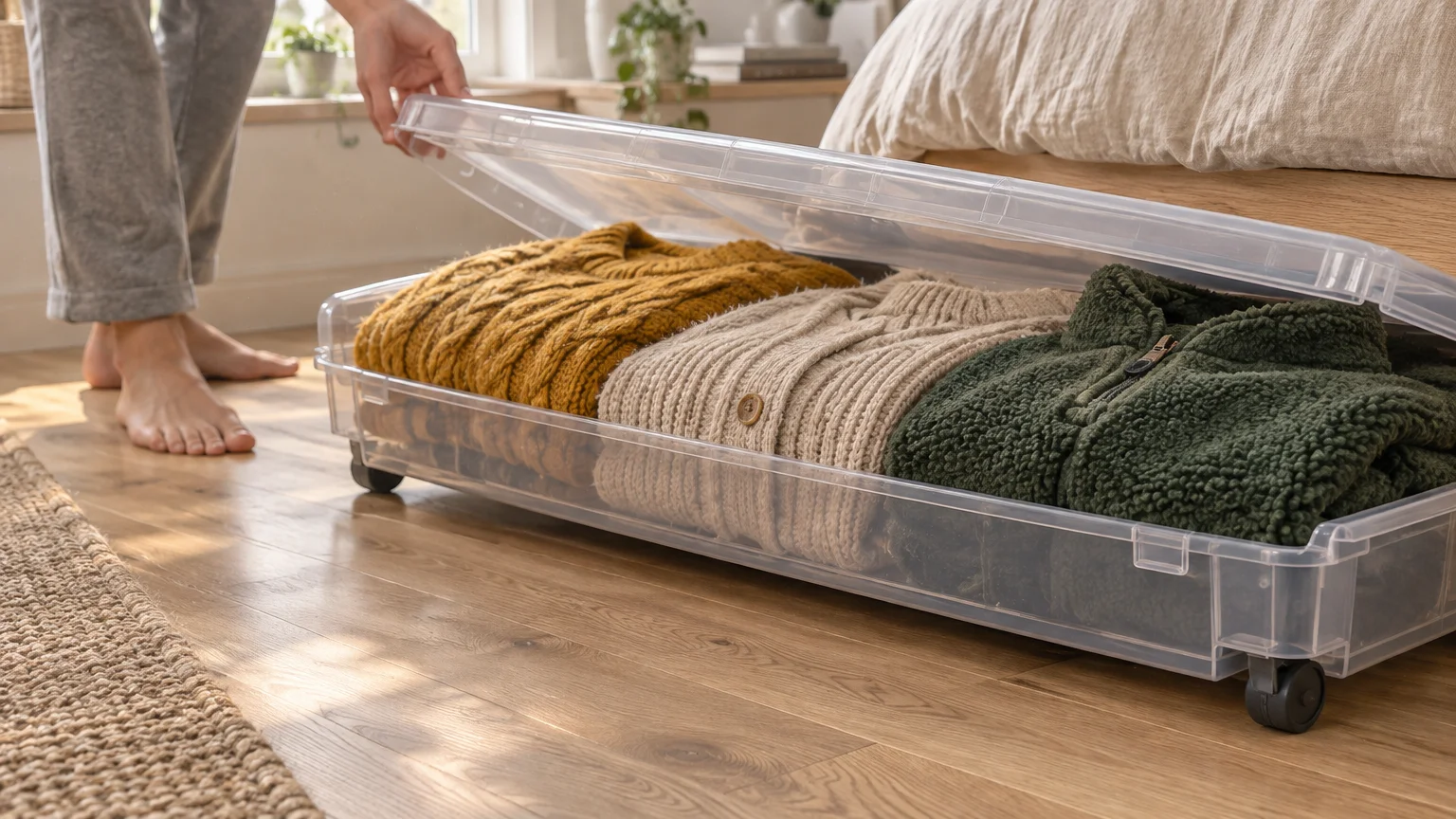
02 Rolling Under-Bed Containers for Heavy Knits and Fleece
Floor space beneath your bed is prime real estate for heavy sweaters, fleece pullovers, and off-season pants. Folding bulky knits flat under the bed also protects their shape far better than cramming them onto hangers.
The CCI advises against hanging knits, bias-cut pieces, or garments with weak shoulders because gravity stretches them out permanently. Flat storage with minimal folds is also the Smithsonian’s top choice for protecting textile structure.
Before ordering under-bed containers, grab a tape measure and check your bed frame from the floor to the lowest obstruction. Look under the side rail and the center support bar, because one low crossbar can block an entire row of bins.
Use these standard bed-frame clearance ranges as a rough guide while you shop:
- Low-profile platform beds: Typically offer 4 to 7 inches of clearance, most often 5 to 6 inches.
- Standard metal bed frames: Usually provide 7 to 9 inches of space beneath the rails.
- Traditional box-spring setups: Often give you 9 to 13 inches of vertical height.
- Bed risers: Commonly add 3 to 8 inches of extra room when you need deeper storage.
Most rolling under-bed bins stand around 6 inches tall, which means they need at least 7 inches of floor-to-rail clearance to glide smoothly. Subtract roughly 1 inch from your lowest frame measurement to leave enough room for the lid to clear.
Do not pack tall bins all the way up against the underside of your mattress. Pushing containers flush against the mattress traps overnight body heat and humidity, which can breed mildew or mold right on the bottom fabric.
Leave a clear air gap between your bin lids and the bed base so air moves freely while you sleep. Choosing bins with built-in wheels and snap-latch lids also makes routine floor vacuuming effortless—just roll the bins out, sweep underneath, and slide them back.
03 Vacuum Storage Bags for Resilient Synthetics and Denim
When closet space is tight, vacuum storage bags can shrink a mountain of puffy winter gear down to a fraction of its normal volume. Used selectively, they free up whole shelves in seconds.
The catch is that extreme compression damages delicate or lofted materials if left sealed for months. Textile care specialists and vacuum bag manufacturers advise limiting vacuum compression to resilient synthetics—like polyester, nylon, and microfiber—plus sturdy cotton and denim.
Ski pants, polyester fleece jackets, microfiber workout layers, cotton hoodies, and jeans bounce back well after unpacking. Keep these fragile or lofted materials completely out of vacuum storage bags:
- Down and feathers: Intense pressure crushes the quills and permanently reduces loft and insulation warmth.
- Wool and cashmere: Compression flattens natural crimp and can felt the fibers together.
- Silk: Vacuum pressure locks in sharp, stubborn creases that are difficult or impossible to remove.
- Leather and suede: Sealed plastic traps moisture against the hide and causes permanent creasing or surface cracking.
Prep clothes carefully before using the vacuum hose so hardware does not ruin the seal. Turn jeans and jackets inside out, zip up metal zippers, and fold bulky snaps inward away from the outer plastic wall.
Do not compress bags into rock-hard bricks if you plan to store cottons for an entire season. Stopping the vacuum slightly before full stiffness leaves enough give to prevent deep creasing while still saving substantial room.
Slide filled vacuum bags flat inside a rigid code 5 polypropylene bin or under-bed drawer instead of stacking bare bags directly on wire shelves. Rigid walls shield the thin film from sharp shelf edges, pet claws, and accidental punctures that ruin the seal.
04 Breathable Cotton Garment Bags for Structured Coats and Suits
Structured winter wool coats, tailored blazers, and formal dresses hold their shape best when hung upright rather than folded into boxes. Giving them breathable protection keeps dust off the shoulders while letting fibers air out naturally.
Never leave seasonal clothes sealed inside thin plastic bags from the dry cleaner. Commercial dry cleaners and the Drycleaning & Laundry Institute (DLI) warn that these thin bags trap residual moisture and cleaning solvents, creating a mildew risk.
Dry cleaner bags also contain BHT (butylated hydroxytoluene), an antioxidant that reacts with moisture and air pollutants to cause phenolic yellowing on light fabrics. Vinyl garment bags made from code 3 PVC are also best avoided.
Swap plastic covers for breathable 100% cotton canvas or unbleached muslin garment bags with zippered closures. Cotton shields garments from dust and light while allowing ambient closet air to circulate slowly around wool and linen fibers.
Support heavy coats with sturdy, shaped hangers instead of thin wire hooks that poke dimples into shoulder seams. The CCI recommends padded wooden or plastic hangers for sturdy hung pieces so weight distributes evenly across the collar and upper back.
Use functional zoning on your closet rod so off-season coats never clutter your daily reach. Slide garment bags holding winter outerwear or summer event dresses into the far left or far right corners of the rod, leaving the central eye-level section open for daily outfits.
Leave an inch or two of breathing room between hanging garment bags rather than jamming them shoulder to shoulder. Crushing coats together flattens sleeve creases and blocks airflow along the back wall of your closet.
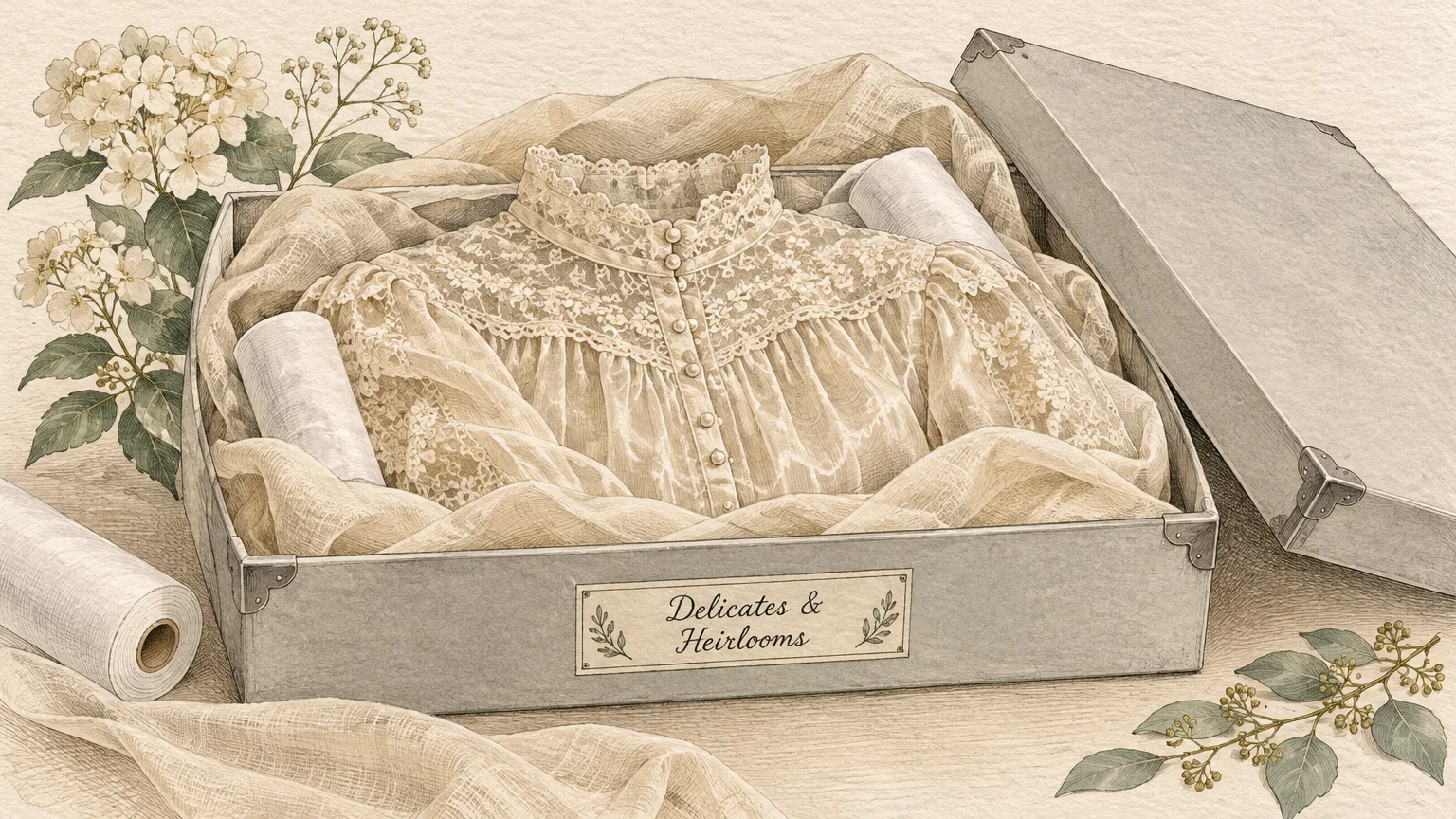
05 Acid-Free Boxes and Muslin Wraps for Delicate Pieces
Silk blouses, heirloom knitwear, beaded evening tops, and soft leather handbags need gentler treatment than everyday denim. Flat archival-style boxing protects fragile seams and keeps light completely away from delicate dyes.
Skip standard brown moving cartons, shoeboxes, and bare wooden chests for delicate fabrics. Both the Smithsonian Institution and The Henry Ford textile conservation guidelines warn against direct contact with bare wood, standard cardboard, or regular tissue paper because they contain acids and lignin.
Over a few seasons, acids and lignin leach into fabric fibers, causing brittle spots and yellowish stains along crease lines. Instead, choose sturdy acid-free, lignin-free archival storage boxes sized to fit comfortably on a bedroom closet shelf.
Line the inside of the box and pad every fold with unbuffered acid-free tissue paper, which the CCI and The Henry Ford specifically recommend for silk, wool, and leather. Clean, washed white cotton or muslin—such as a soft old cotton sheet—works just as well.
When folding a delicate dress or scarf, stuff rolled tubes of tissue or clean muslin inside each bend instead of pressing sharp creases flat. Padding the fold creates a gentle curve so fibers do not snap under their own weight.
If you keep sentimental or special-occasion items boxed for more than one season, unpack and refold them along different lines periodically. The Smithsonian recommends rotating fold lines so stress never settles permanently along the exact same threads.
06 Over-the-Door Canvas Organizers for Seasonal Accessories
Small seasonal accessories—like knit beanies, wool gloves, winter scarves, swimsuits, and lightweight sandals—disappear easily at the bottom of deep bins. Hanging a vertical pocket organizer on the back of a closet or bedroom door keeps small gear visible and off your floor.
Skip cheap hanging organizers with thin clear plastic windows, because those pockets often use code 3 PVC that turns cloudy, cracks in cold bedrooms, and harms delicate knits. Look for heavy cotton canvas, breathable polyester fabric, or code 5 polypropylene cubbies instead.
Check your door hardware before ordering an over-the-door rack so it hangs smoothly without damaging trim. Standard interior residential doors typically measure 1-3/8 to 1-3/4 inches thick, and the top frame needs a slight gap so metal brackets do not scrape paint or jam the latch.
Stick to organizers that project no more than 5 to 6 inches from the door surface. Slim profiles let your closet door swing all the way open without banging into walls or crushing hung sleeves inside.
Use the top pockets for bulky winter hats or summer sun hats that crush easily in bins, and save lower pockets for heavy scarves or flip-flops. Group tiny pairs—like leather gloves or wool socks—inside small cotton drawstring pouches so single items never stray.
If your closet lacks a solid door, hang a sturdy fabric cubby organizer directly from one end of your closet rod. Dedicate one vertical column to off-season accessories and slip folded index cards into the front pocket slots so you remember what sits inside.
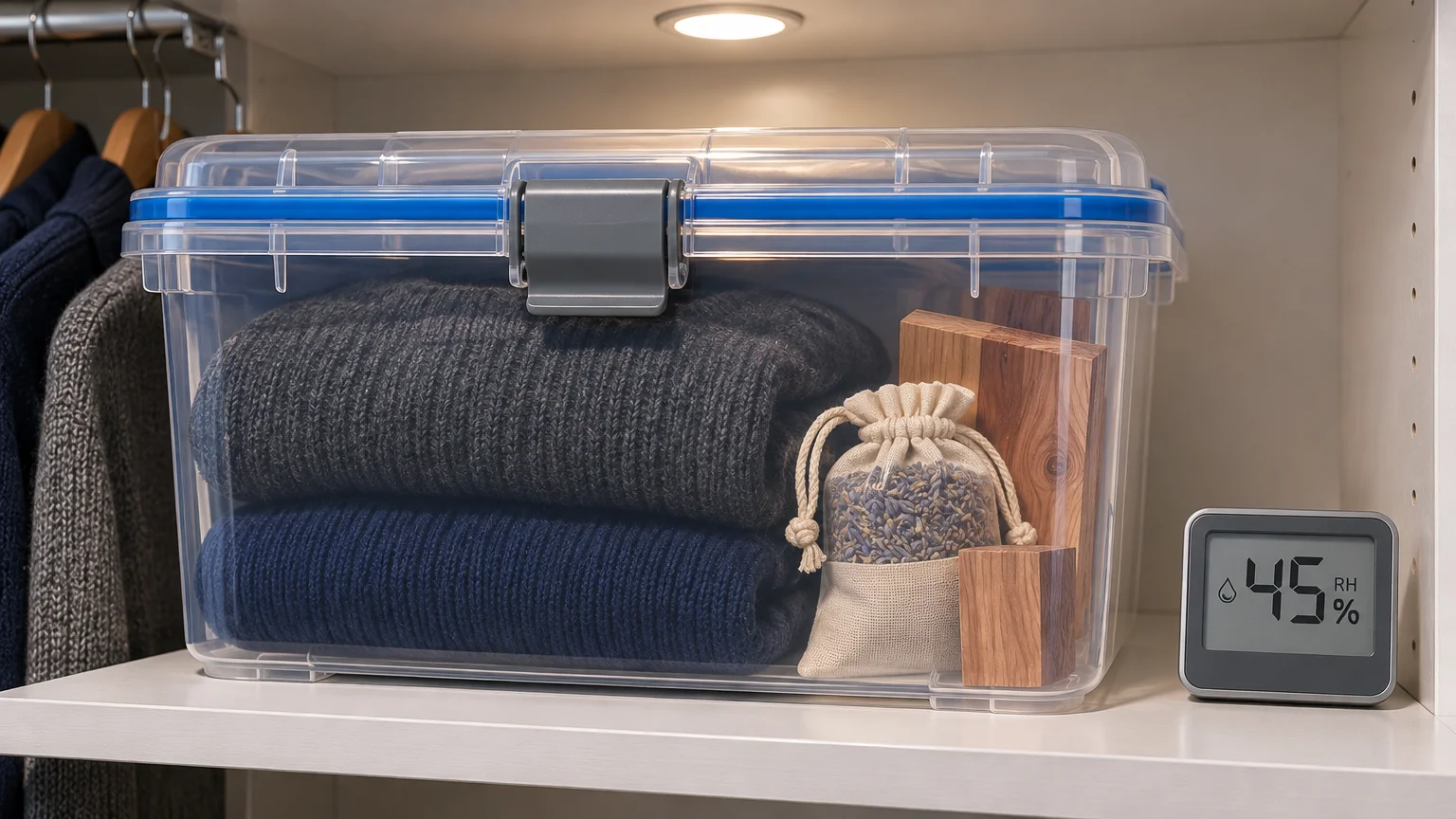
07 Airtight Gasket Bins with Safe Moth Prevention for Wool
Pure wool, cashmere, alpaca, and silk-wool blends face a silent threat during off-season storage: clothes moth larvae. A single overlooked stain plus an unsealed lid can leave tiny holes across your favorite winter sweaters by autumn.
Many people toss cedar blocks or lavender sachets into sweater drawers hoping for total protection. However, UC IPM reports that aromatic eastern red cedar oil only kills small larvae—not large ones—and loses potency after several years unless you lightly sand the wood.
UC IPM also notes that very little is known about how well herbal repellents like lavender actually deter clothes moths. An airtight container protects your woolens far more reliably than wood chips or scent bags ever will.
Pre-treat clean, vulnerable woolens with controlled heat or cold before locking them inside an airtight code 5 polypropylene gasket bin. UC IPM outlines three proven methods that kill every clothes moth life stage:
- Hot laundering: Wash sturdy washable woolens or cotton-wool blends for 20 to 30 minutes at 120°F (49°C) or hotter, or send delicate pieces to a dry cleaner.
- Dry heat: Heat dry garments above 120°F for at least 30 minutes when safe for the specific fiber care label.
- Deep freezing: Seal dry clothes inside a plastic bag and freeze below 18°F (-8°C) for several days—household and museum guides commonly recommend 14 days at 0°F (-18°C).
Once items return to room temperature and feel completely dry, pack them straight into a hard-sided bin fitted with a foam or silicone lid gasket. Snap every latch shut so adult moths cannot squeeze through gaps to lay eggs.
Resist the urge to drop traditional mothballs into your storage bins or closet corners. According to the U.S. Environmental Protection Agency (EPA) and the National Pesticide Information Center (NPIC), U.S. mothballs are nearly 100% naphthalene or paradichlorobenzene—potent fumigant pesticides governed by strict federal label laws.
Under federal law, mothballs may only be used inside closed, airtight containers—requiring a minimum of 7 days on EPA-registered indoor labels—and must never sit in open closets or outdoors. Both EPA-registered labels and UC IPM warn that their toxic vapors cause headaches, nausea, respiratory irritation, and poisoning risks for children and pets, while naphthalene labels carry a California cancer warning.
Paradichlorobenzene vapors also soften and melt certain plastics, including plastic buttons, hangers, and non-polyethylene or non-polypropylene bins. Relying on thorough cleaning, heat or freeze prep, and clean airtight gasket bins keeps both your clothes and your indoor air safe.
Match Every Garment to the Right Storage Container
Standing in front of a pile of seasonal clothes gets much easier when you pair each fabric with its safest home. Use this quick reference table to match your clothing storage tips to the containers you already own or plan to buy.
| Garment Type | Best Storage Method | Safe Container & Prep Spec | What to Avoid |
|---|---|---|---|
| Wool & cashmere sweaters | Airtight gasket bins or rolling under-bed bins | Code 5 PP plastic; clean first, fold flat with acid-free tissue | Hanging on hangers, vacuum bags, mothballs in open closets |
| Puffer coats & ski wear (synthetic) | Vacuum storage bags inside rigid bins | Polyester/nylon/microfiber only; zip hardware inward | Compressing down feathers or leaving bare bags near sharp wires |
| Down jackets & vests | Breathable cotton garment bags or large bins | Uncompressed hang on padded hanger or loose fold in code 5 PP bin | Vacuum storage bags, which crush feather quills permanently |
| Tailored coats & suits | Cotton or muslin garment bags | Padded wooden or plastic hangers; 1–2 inch spacing on closet rod | Dry cleaner plastic bags (BHT yellowing) and code 3 PVC bags |
| Silk, lace & delicate tops | Acid-free archival boxes | Acid-free, lignin-free box lined with unbuffered tissue or muslin | Standard cardboard, bare wood chests, and vacuum compression |
| Denim, fleece & cotton tees | Rigid shelf bins or vacuum bags | Code 2, 4, or 5 plastic bins; wash clean and dry completely first | Attics, basements, garages, and sealing damp fabrics |
| Leather jackets & suede boots | Cotton wraps in climate-controlled closet | 64–68°F, 45–55% RH; padded hanger or acid-free box with muslin | Vacuum sealing, damp spaces over 65% RH, and bare plastic contact |
| Hats, scarves & swimwear | Over-the-door canvas pocket organizer | Canvas or fabric pockets paired with cotton pouches for small pairs | Clear PVC pockets and overstuffed door brackets |
Keep Your Seasonal Wardrobe Swap Simple
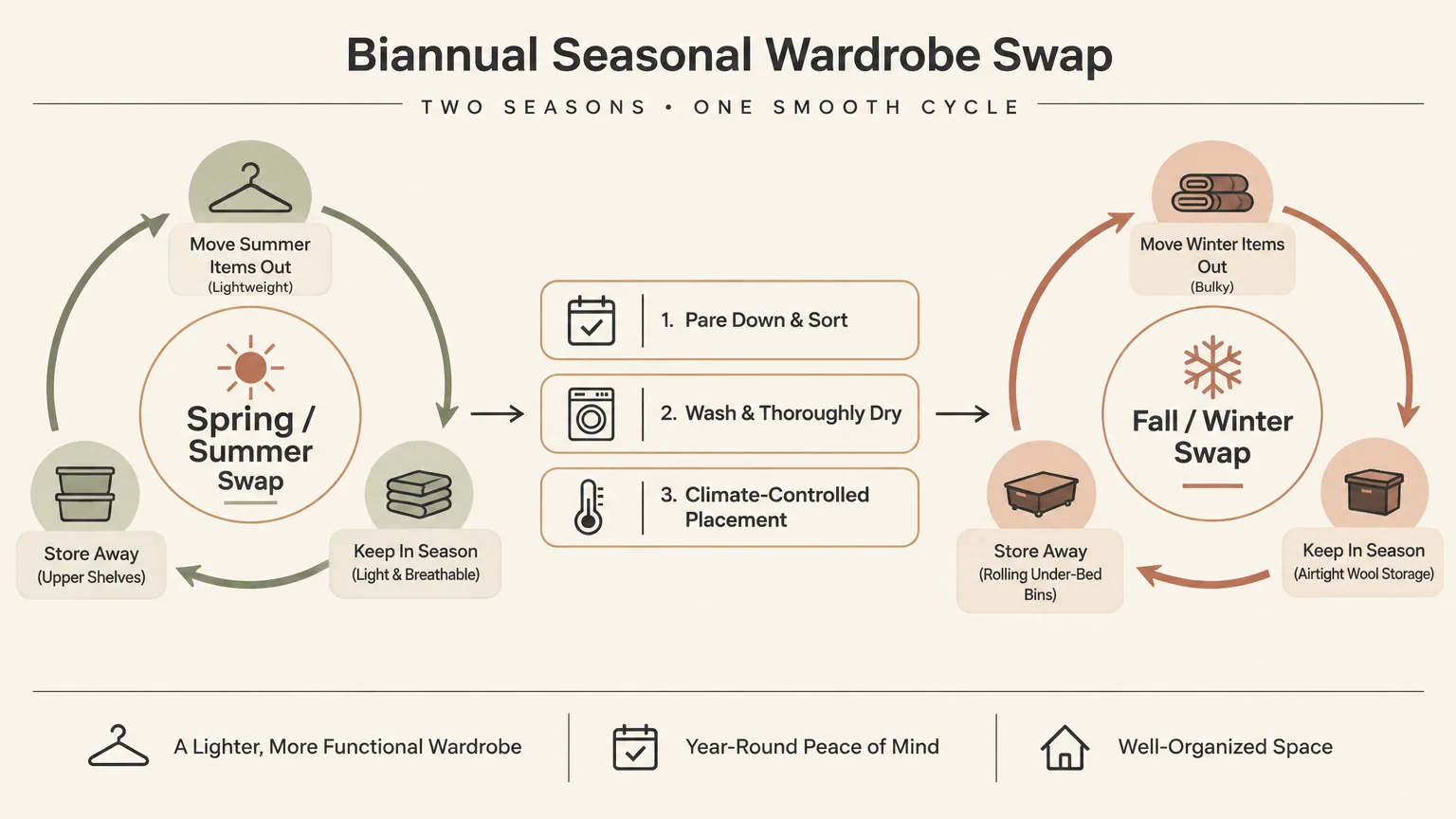
The best storage system is one you can maintain twice a year without losing an entire weekend to clutter. Pick two fixed calendar dates—such as the first weekend of spring and the first weekend of fall—to rotate your seasonal wardrobe.
Follow this low-friction swap checklist every six months:
- Clear the daily zone first: Pull outgoing seasonal clothes off your central closet rod and eye-level shelves so you have open workspace.
- Inspect stored bins before unpacking: Check airtight lids, look for any dampness or musty smells, and refold boxed delicates along fresh lines as needed.
- Wash outgoing items immediately: Toss worn sweaters and summer tees straight into the laundry hamper before packing them away, never unwashed.
- Move current-season pieces to prime real estate: Place everyday outfits at eye level and return labeled off-season bins to upper shelves or under the bed.
For your practical next step today, walk to your bedroom closet with one empty laundry basket and pull out five off-season items you know you will not wear for months. Wash or spot-check them tonight, pick one clean bin or breathable cotton cover from this guide, and move those five pieces out of your daily morning space.