
A well-placed bedroom rug instantly anchors your space, softens your mornings, and protects your floors from daily wear and tear. Getting the dimensions right makes the difference between a cramped, awkward room and a balanced, calming retreat. The key is matching the rug size to your specific bed—whether you sleep in a cozy twin or a spacious California king—and ensuring proper clearance around your furniture. In this guide, you will learn the exact measurements and placement rules interior designers use to pull a room together. You will also discover practical ways to arrange runners in tight spaces and essential safety tips to keep your rugs securely anchored, preventing dangerous slips and trips.
The Core Principles of Bedroom Rug Placement
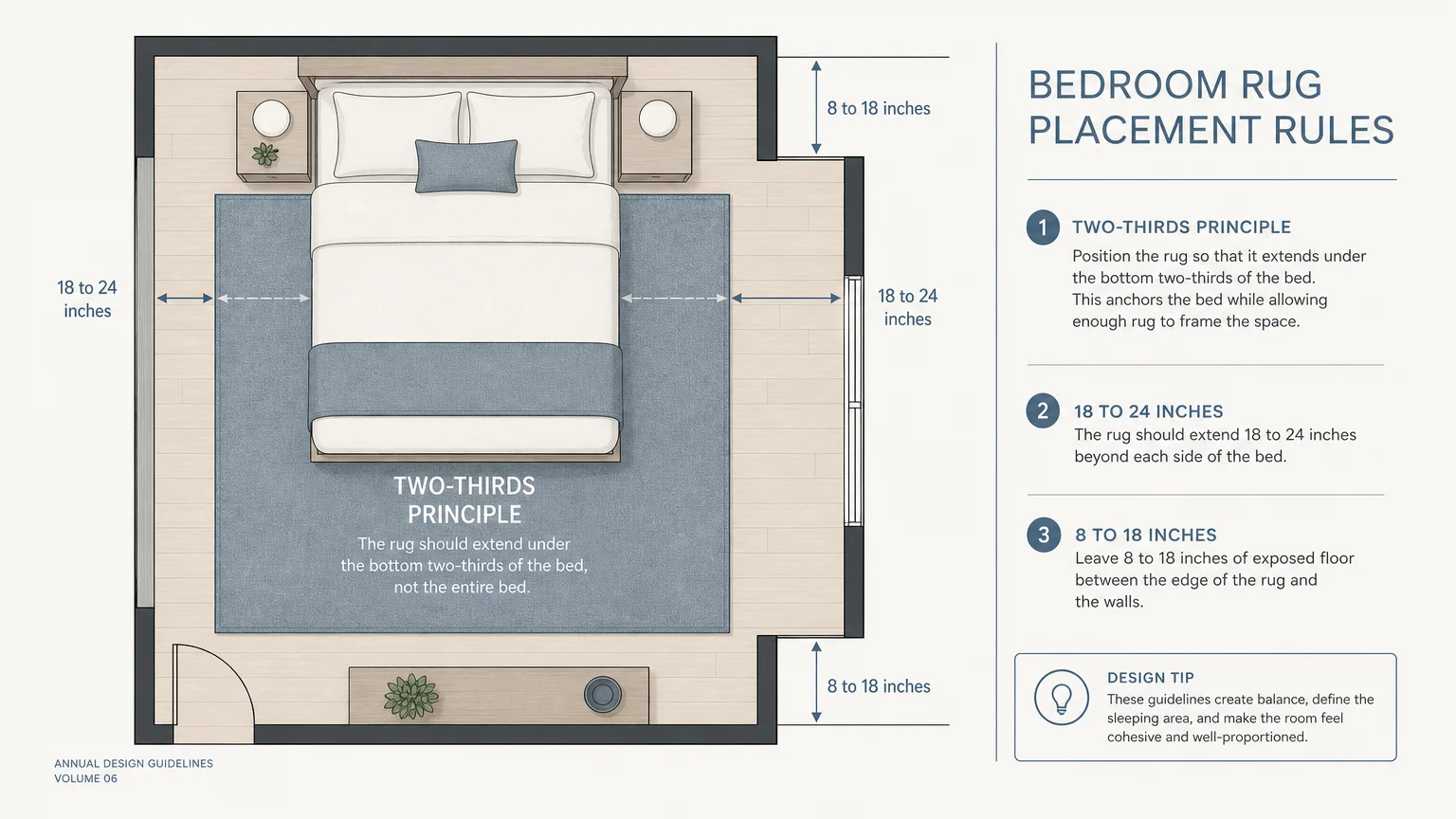
Placing a rug in your bedroom is not just about putting something soft under your feet; it is about establishing visual balance. Think of your area rug as a frame for your bed. If the frame is too small, the bed looks oversized and overwhelming. If the frame is too large and touches the baseboards, the room feels like it is covered in poorly installed wall-to-wall carpet.
Interior designers generally follow the one-third principle. This rule dictates that at least the bottom third of your bed frame should sit directly on the rug. However, for maximum visual impact and comfort, pulling the rug two-thirds of the way up the bed is even better. You want the rug to extend out from the sides and the foot of the bed. Aim for 18 to 24 inches of visible rug extending on each side. This guarantees that when you swing your legs out of bed in the morning, your feet land on warm fabric rather than a cold, hard floor.
Additionally, pay attention to the perimeter of the room. A beautifully placed area rug needs breathing room. Maintain a consistent border of exposed hard flooring—typically 8 to 18 inches—between the edges of the rug and the bedroom walls. This negative space visually expands the room and highlights the contrast between your hard floors and your plush textiles. If your bedroom is exceptionally large, you can easily leave up to 24 inches of bare floor around the edges to emphasize the spaciousness of the room.
Prioritizing Safety: Preventing Trips and Slips in the Bedroom
While aesthetics are important, safety must be your top priority when introducing textiles to your floors. This is particularly crucial for older adults or anyone looking to simplify their daily routines and reduce household hazards. Loose, unsecured rugs are significant environmental hazards that routinely cause accidents in the bedroom.
According to research on slipping and tripping injuries, an estimated 37,991 adults aged 65 and older are treated in emergency departments each year for falls associated with carpets and rugs. The transition between a rug and a hard floor, as well as damaged or curled edges, are prime locations for tripping. To combat this, the National Institute on Aging (NIA) recommends removing small throw rugs entirely or ensuring that all carpets are fixed firmly to the floor.
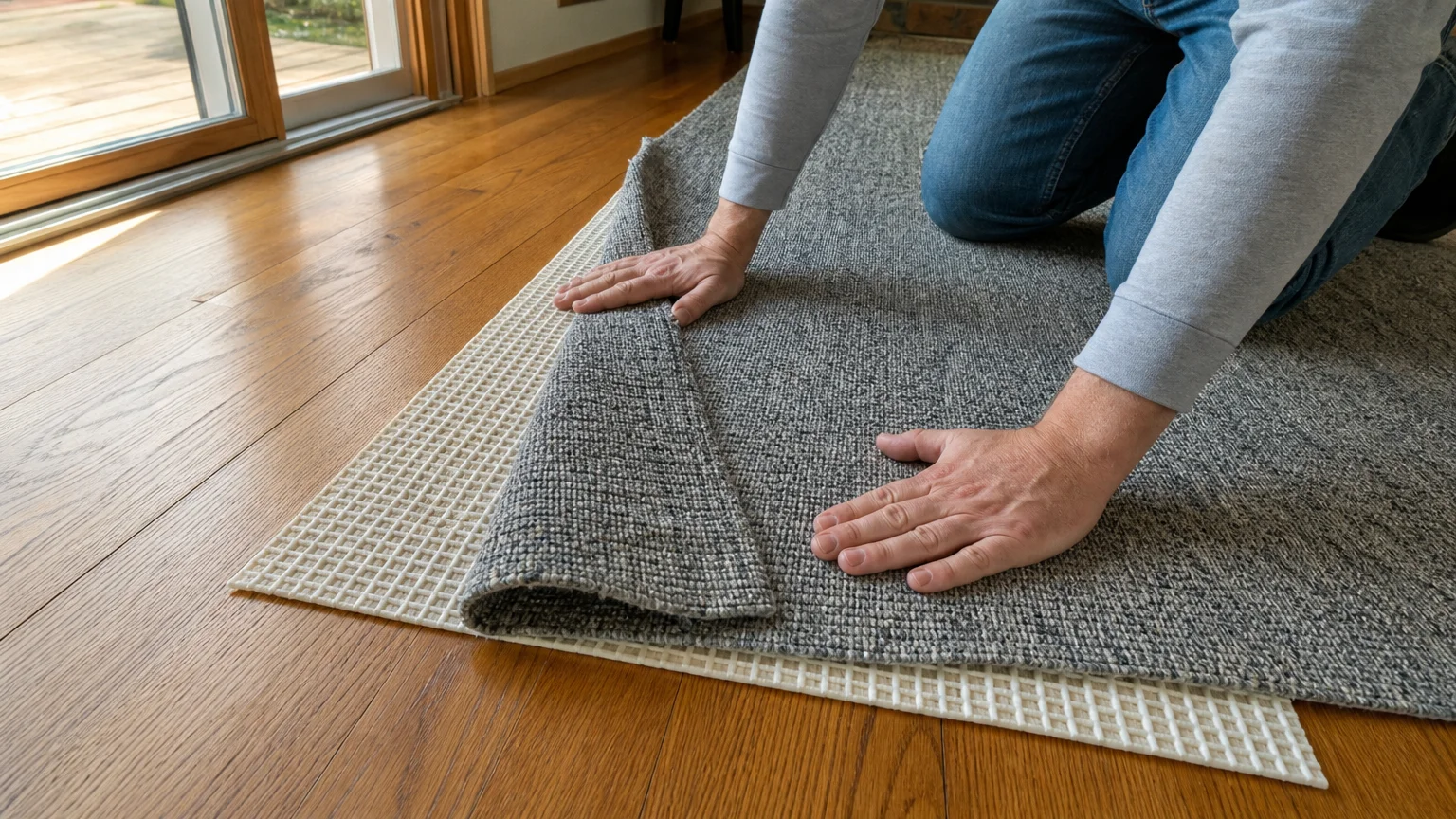
If you choose to use an area rug or runner, you must secure it properly. Never place a rug directly onto hardwood, laminate, or tile without a high-quality, non-slip rug pad underneath. For smaller accent rugs or runners, apply double-sided carpet tape to the corners and edges. If your rug begins to buckle or the corners curl upward over time, tape them down immediately or replace the rug. Those who use mobility aids—such as walkers or canes—should avoid thick shag or high-pile rugs; instead, opt for low-pile or flatweave options that allow for smooth, unobstructed movement across the room.

Health Considerations: Rugs, Allergies, and Asthma
Another practical element to consider is indoor air quality. Your bedroom is where you spend roughly a third of your life, and the materials you bring into it directly affect your respiratory health. Carpets and rugs act like massive filters for your home, trapping airborne particles that settle out of the air over time.
The American Lung Association notes that carpets and rugs can trap pollutants and allergens like dust mites, pet dander, mold spores, and dirt. If you or a family member struggles with asthma or severe allergies, you need to manage your bedroom rug carefully. When particles become trapped deep in the pile, they can easily become airborne again during vacuuming or even just by walking across the room.
To minimize allergy triggers, choose a low-pile rug made from natural fibers like wool, or select an easily washable cotton flatweave. Wool naturally resists dust mites and bacteria, making it an excellent choice for a healthy bedroom. Avoid installing wall-to-wall carpeting or bringing in deep shag rugs if allergies are a major concern. Furthermore, commit to a strict cleaning routine. Vacuum your bedroom rug at least once a week using a vacuum cleaner equipped with a HEPA filter to safely capture fine particles without exhausting them back into your sleeping environment.
Matching Rug Sizes to Your Specific Bed Size
Selecting the right rug size requires knowing the exact dimensions of your mattress and your room. A tiny rug under a massive bed looks like a postage stamp, while an oversized rug in a tight room feels suffocating. Use the following guidelines to find the perfect pairing for your specific bed and avoid common home decorating mistakes.
Here is a quick reference table to help you match your bed size to the ideal rug dimensions:
| Bed Size | Standard Mattress Dimensions | Recommended Area Rug Size | Runner / Accent Alternative |
|---|---|---|---|
| Twin / Twin XL | 38″ x 75″ (or 80″) | 5′ x 8′ or 6′ x 9′ | 2′ x 6′ (placed on one side) |
| Full (Double) | 54″ x 75″ | 6′ x 9′ or 8′ x 10′ | 2′ x 6′ (on both sides) |
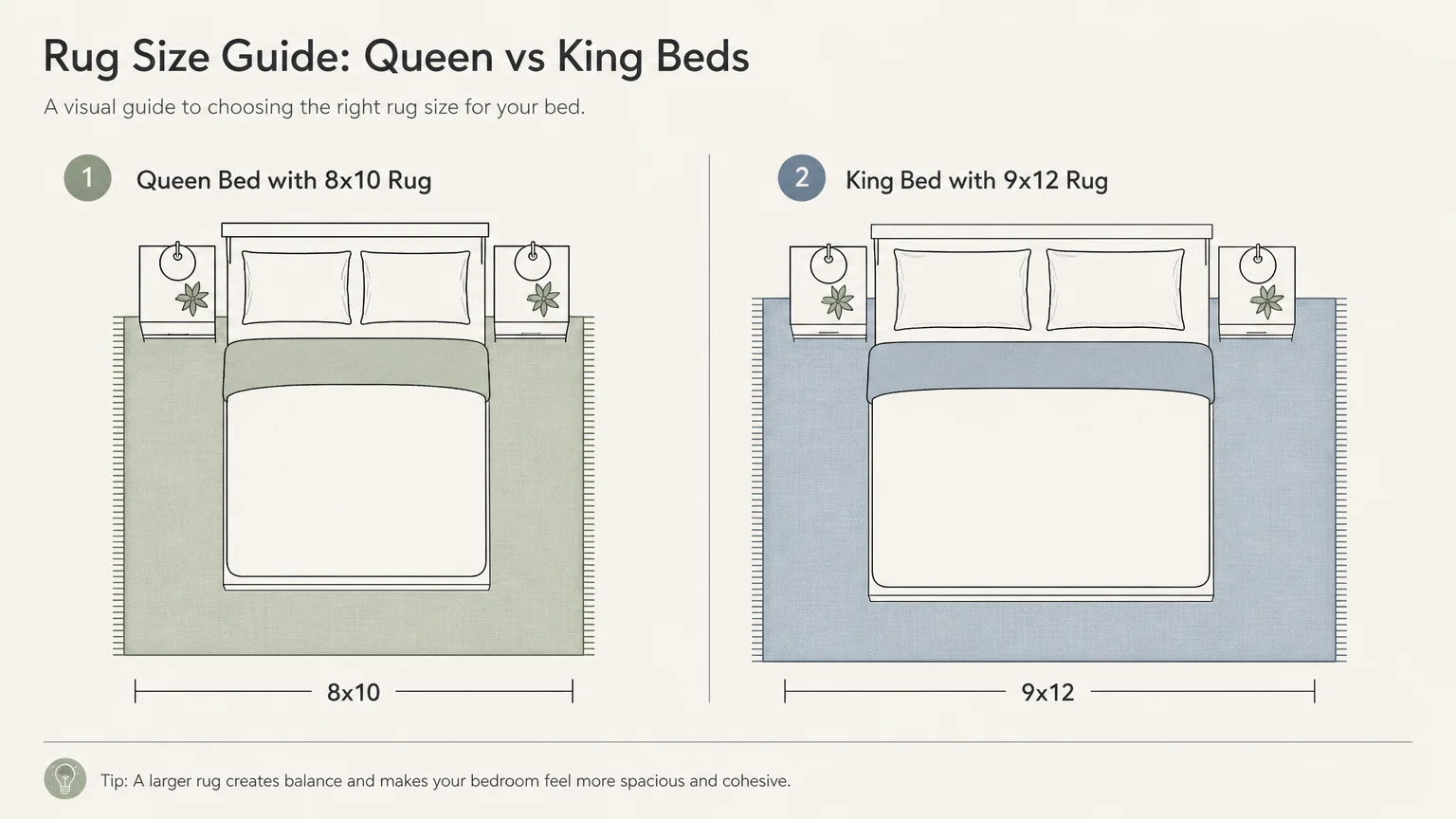
| Queen | 60″ x 80″ | 8′ x 10′ | 2′ x 8′ (on both sides) |
| King / California King | 76″ x 80″ (or 72″ x 84″) | 9′ x 12′ or 10′ x 14′ | 2′ x 8′ or 3′ x 5′ (on sides or foot) |
Placing a Rug Under a Twin or Twin XL Bed
Twin beds are typically pushed up against a corner or a wall to maximize floor space in children’s rooms or small guest spaces. Because the bed is asymmetrical in the room, placing the rug requires a different approach. A 5×8 foot rug is generally the perfect size for a single twin bed.
Instead of trying to center the rug under a bed that sits against the wall, slide the rug under the bottom two-thirds of the bed, allowing the rug to extend horizontally out into the open part of the room. This placement anchors the bed while providing a large, soft walking space right where you step down. If the room features two twin beds separated by a single nightstand, place one 3×5 foot or 2×6 foot runner directly between them. This cost-effective strategy unites the two beds, defines the shared space, and gives both sleepers a comfortable landing spot without requiring a massive area rug.
Ideal Placements for Full and Queen Beds
Full and queen beds are the standard for most primary and guest bedrooms, usually positioned in the center of the longest wall with nightstands on either side. A queen bed measures 60 inches wide by 80 inches long, requiring a substantial footprint to maintain visual harmony.
For a standard queen bed, an 8×10 foot area rug is the gold standard in interior design. Place the rug perpendicular to the bed. Pull it down so the top edge stops just short of the front legs of your nightstands. This leaves the nightstands sitting firmly on the hard floor, preventing them from wobbling, while still giving you 18 to 24 inches of plush coverage on the sides and foot of the bed.
If you are working with a smaller room and an 8×10 rug touches the baseboards, scale down to a 6×9 foot rug. When using a 6×9 under a queen bed, you must slide it further down toward the footboard. The rug will only extend about 12 to 18 inches on the sides, but it will still frame the bottom third of the bed beautifully and provide warmth where your feet hit the floor.
King and California King Bedroom Decor Strategies
A king-size bed is a massive piece of furniture. Skimping on the rug size here is one of the most common interior design mistakes. An 8×10 foot rug barely extends past the sides of a standard king bed, rendering it almost invisible and leaving you with little usable soft space when you step out of bed.
To properly anchor a king or California king bed, you need a 9×12 foot rug. Lay it perpendicularly, starting it right in front of the nightstands. This provides an expansive, luxurious border around the bed. If your primary suite is exceptionally large—perhaps featuring a seating area, a heavy wooden bench at the foot of the bed, or oversized nightstands—step up to a 10×14 foot rug. With a 10×14 rug, you can place the entire bed frame, both nightstands, and the end-of-bed bench completely on the rug. This setup creates a unified, high-end hotel aesthetic and ensures that no furniture pieces sit unevenly on a floor transition.
Alternative Placements: Runners and Small Accent Rugs
Not every bedroom requires a massive area rug. Large rugs are heavy, expensive, and difficult to clean. If you are decorating on a budget, prefer the look of bare hardwood, or simply do not want to wrestle a 9×12 rug under a heavy mattress, runners are an excellent alternative.
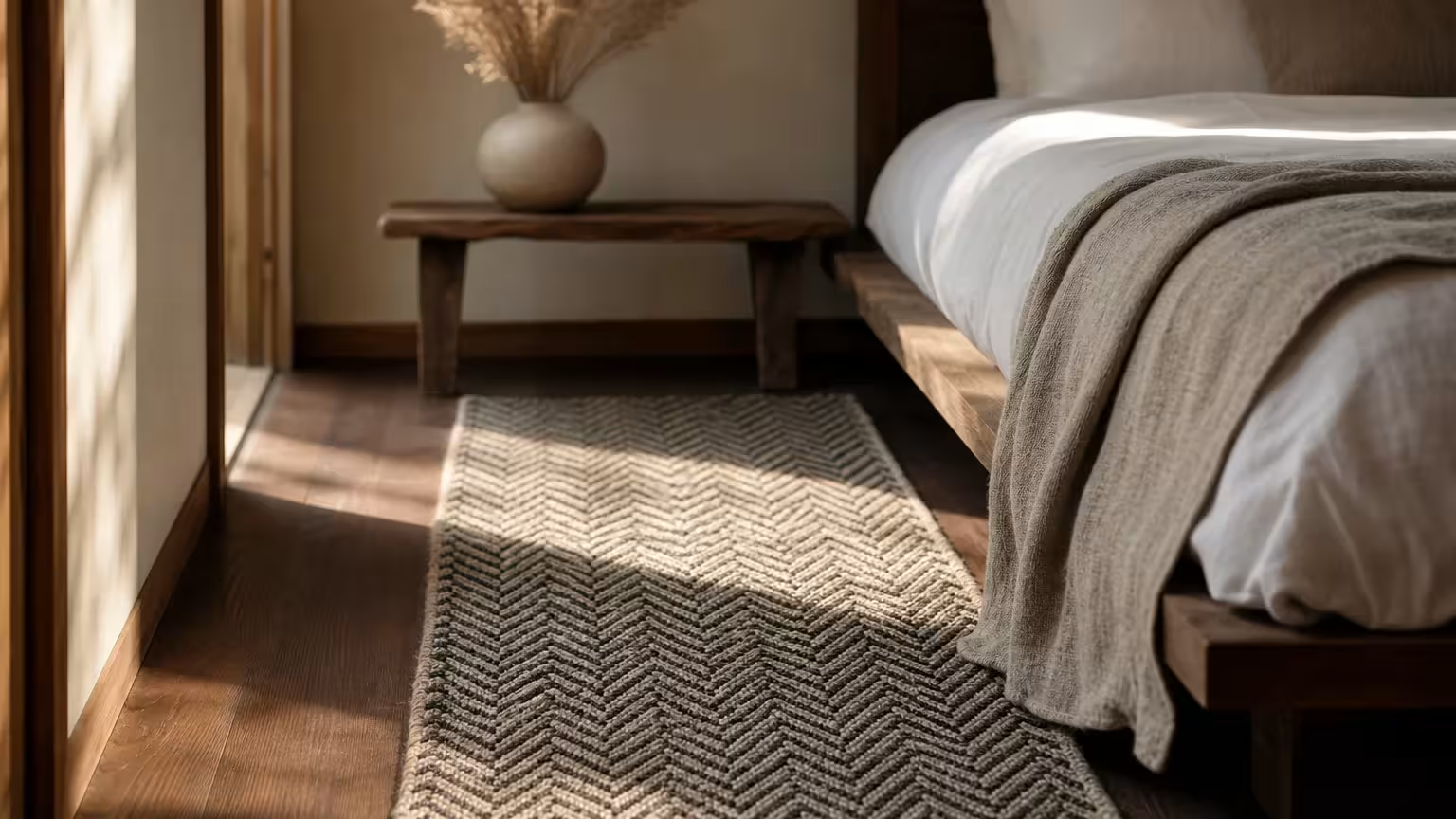
Runners offer the same functional benefit—a soft landing spot for your feet—without the bulk. Place a 2×6 or 2×8 foot runner along each side of the bed. Center the runners alongside the mattress, stopping them just before the nightstands. If you have a bench or trunk at the end of your bed, you can place a third runner horizontally across the foot of the bed.
When evaluating runners, pay attention to the width as well as the length. A standard 2-foot wide runner provides just enough space to step down comfortably. However, if your bedroom is exceptionally wide, a 3-foot wide runner fills the visual gap between your bed frame and your walls much more effectively. You can mix and match textures when using smaller rugs, too. A plush, high-pile runner right next to the bed offers a luxurious feel for bare feet, while a durable, flatweave accent rug at the foot of the bed stands up to the heavy foot traffic of getting dressed and putting on shoes.
This modular approach makes cleaning incredibly easy. You can pick up a lightweight runner, shake it out outside, or throw it in the washing machine. It is a highly practical solution for older adults who want to easily maintain a clean home without lifting heavy furniture.

Navigating Unique Bedroom Layouts and Asymmetry
Sometimes, standard sizing rules do not apply because the room layout dictates otherwise. If your bedroom features an asymmetrical design, such as an off-center fireplace, a bay window, or a corner door, you have to adjust your rug placement to accommodate the flow of traffic.
In asymmetrical rooms, align the rug with the bed rather than the walls. The bed is the focal point, and the rug should serve to highlight it. If pushing the rug under the bed leaves one side of the rug blocking a doorway or overlapping an air vent, simply pull the rug slightly off-center relative to the bed to clear the obstacle. While perfect symmetry is the goal, practical functionality must always win. Never allow a rug to impede a door from opening smoothly or cover an active HVAC vent.
Consider the placement of your bedroom furniture beyond the bed itself. If you have a heavy dresser, a vanity, or a large reading chair, decide whether these pieces will sit entirely on the rug, entirely off the rug, or with just their front legs on the rug. The front-legs-on approach is a classic interior design technique that visually connects secondary furniture to the main sleeping area without requiring an oversized carpet. If you choose this method, ensure your dresser or bookshelf remains perfectly stable. You might need to add small furniture shims under the back legs so the piece does not tilt backward against the wall.
If you are layering an area rug over existing wall-to-wall carpeting, the same size guidelines apply, but the texture becomes more critical. To prevent the area rug from buckling over plush carpet, choose a stiff, heavy-backed rug and avoid high-pile shags. You will still need a specialized rug pad designed specifically for carpet-to-carpet applications to prevent the top rug from shifting as you walk on it.
Step-by-Step Checklist for Laying Your Bedroom Rug
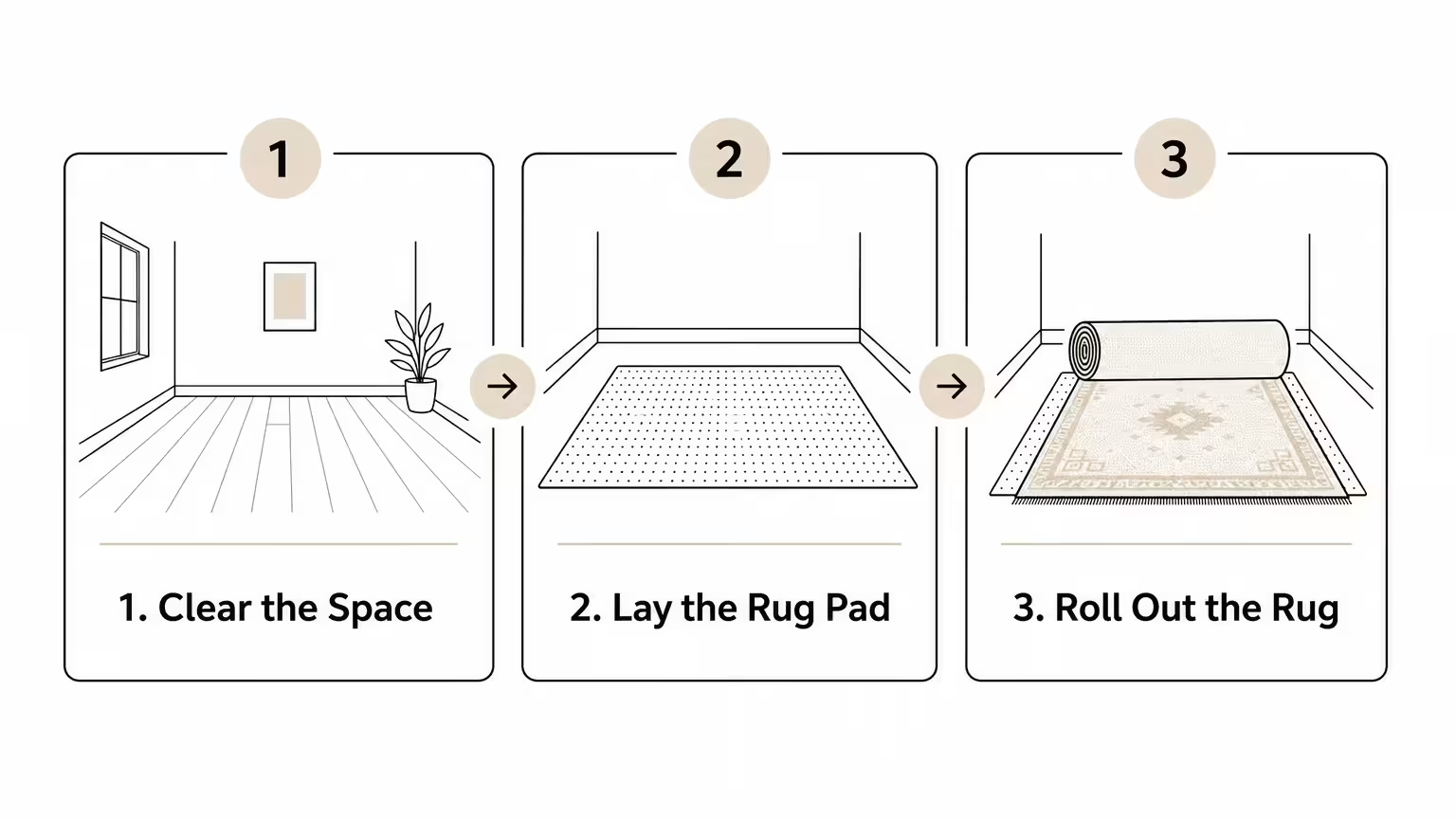
Positioning a large rug under a heavy bed can be physically demanding. Trying to lift a mattress and frame while simultaneously straightening a heavy wool rug often leads to frustration, back strain, and wrinkled carpets. Follow this step-by-step checklist to lay your bedroom rug safely and smoothly.
- Clear the space: Remove all light furniture, including nightstands, benches, and lamps. Strip the heavy blankets and pillows off the bed to reduce the overall weight.
- Mark your placement: Grab a tape measure and use painter’s tape to mark exactly where the top corners of the rug should sit. This prevents you from having to guess and readjust once the rug is trapped under the bed.
- Roll the rug tightly: Unpack your rug in another room and roll it up tightly along its width, with the top side facing inward. If you are using a rug pad, lay the pad down first and secure it with double-sided tape before bringing the rug in.
- Move the bed frame (Option A): If your bed frame is relatively light or on glides, push the entire bed out of the way. Lay the rug flat according to your tape marks, smooth out any wrinkles, and push the bed back into place.
- Slide the rug under (Option B): If your bed is too heavy to move completely, have a partner lift the foot of the bed. Unroll the first few feet of the rug under the legs. Then, move to the sides of the bed. Have one person lift the side rail while the other person unrolls the rug further under the bed. Work your way up toward the headboard until you reach your painter’s tape marks.
- Anchor the edges: Once the rug is positioned, press down all the edges. Apply rug tape to any corners that want to curl upward.
- Add corner grips for extra security: Even if your rug is firmly placed under a massive king bed, the exposed corners at the foot of the bed are prone to shifting. Apply specialized triangular rug grips to these outer corners. These grips stiffen the edge of the rug and adhere gently to the hard floor, ensuring your vacuum cleaner will not suck up the corners and cause the material to fray.
- Let it settle: Allow the rug to sit flat for 24 hours before placing heavy end-of-bed benches or trunks on the outer edges. This gives the fibers time to relax and drop any creases from shipping.
Grab a tape measure right now and map out your ideal rug dimensions on your bedroom floor using painter’s tape to see exactly how it will fit before you make a purchase.