
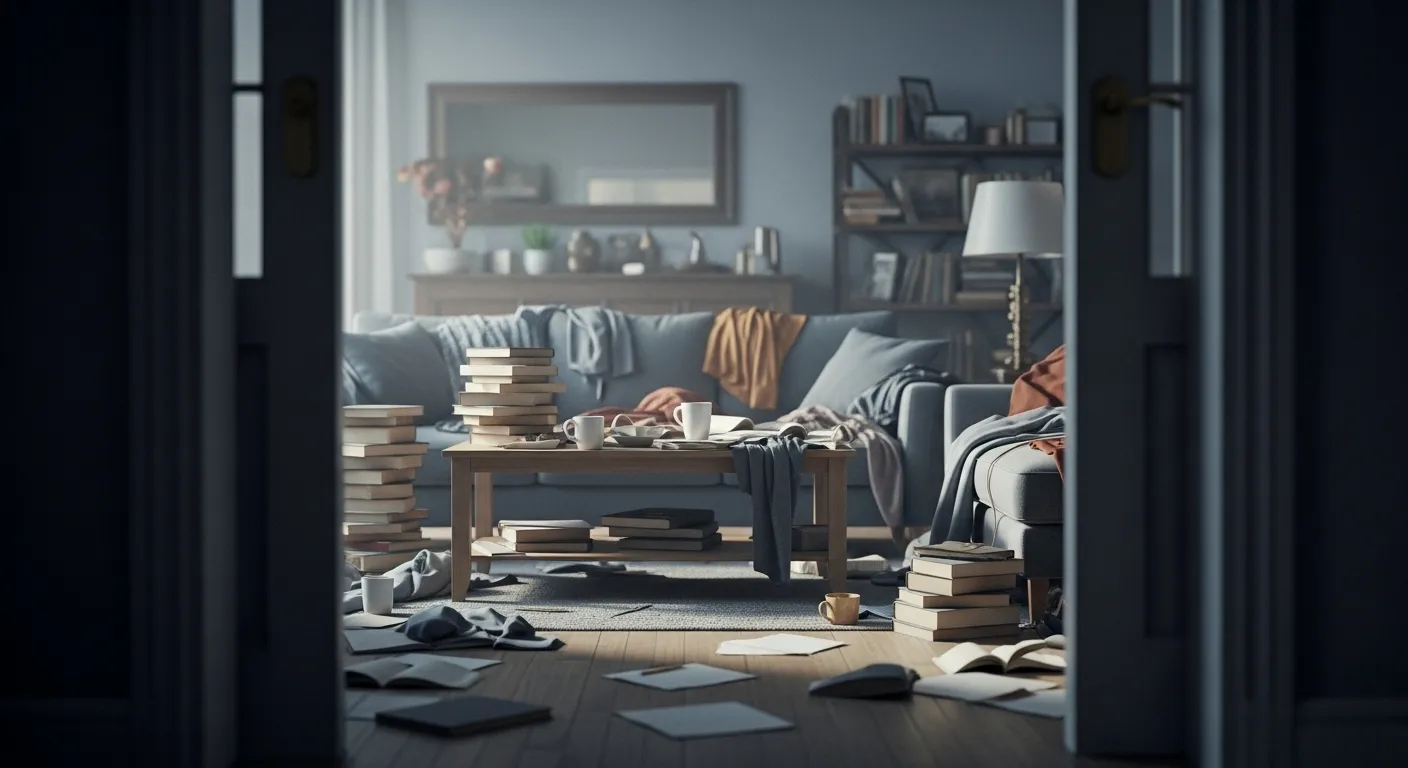
The Hidden Costs of Clutter on Your Mental Wellness
While we often focus on the visible chaos of clutter, its invisible impact on our mental and emotional health is far more significant. A chronically cluttered environment can act as a low-grade, persistent stressor, subtly eroding your sense of well-being over time. Understanding these hidden costs can be a powerful motivator for change.
Our brains are wired to interpret visual order and disorder. A tidy, organized space signals calm and safety, allowing the mind to rest. Conversely, a chaotic space constantly sends signals that work is left to be done, preventing true relaxation and mental recovery.
Increased Cortisol and Chronic Stress
Research from the field of psychology suggests a link between cluttered home environments and higher levels of the stress hormone cortisol, particularly in women. A cluttered space bombards our minds with excessive stimuli—every object you see is something your brain has to process. This constant sensory input can keep your nervous system in a state of high alert, contributing to feelings of anxiety and chronic stress. Clearing physical clutter can literally help clear your mind, lowering this background tension. For more information on stress and its effects, the National Institutes of Health provides a wealth of resources.
Cognitive Overload and Reduced Focus
Your ability to focus is a finite resource. In a cluttered room, countless objects are competing for your attention. This distraction makes it significantly harder to concentrate on a single task, whether it’s working from home, reading a book, or having a conversation with a family member. Your brain is forced to work overtime to filter out the irrelevant visual noise, which can leave you feeling drained, irritable, and less productive. A simplified environment reduces this cognitive load, freeing up mental energy for the things that truly matter.
Decision Fatigue: Too Many Choices, Too Little Energy
Have you ever felt too tired to even decide what to have for dinner? This is decision fatigue, a state of mental exhaustion that results from making too many choices. A cluttered home is a minefield of deferred decisions. Every pile of papers, every box of “miscellaneous” items, and every overstuffed closet represents a decision that has been put off. Living in this environment means you are constantly, subconsciously reminded of this backlog of choices, draining your mental reserves before you even start your day. Decluttering helps eliminate this source of fatigue, simplifying your daily routines.
Safety and Health Hazards
Beyond the mental toll, clutter can pose real physical risks. Piles of items on the floor are tripping hazards, especially for children and older adults. Clutter in the kitchen can create fire risks if it’s too close to heat sources. Towers of boxes can become unstable and fall. Furthermore, clutter traps dust, pet dander, and other allergens, which can degrade indoor air quality and aggravate respiratory issues. The U.S. Consumer Product Safety Commission (CPSC) offers guidance on maintaining a safe home, which includes keeping pathways and exits clear.






22 Responses
This article was very informative and helpful for this phase in my life! I am a Public School Teacher, a retiree after 42 years of teaching! And as you may know, we are coneseuers of fine goods at home and at school! My mother died & my sister which means I have some of their goodies in my cluttered house! This article boosted my desire to get busy and declutter before I become a hoarder! My family already thinks I am! I am NOT! Thank you so much! 😊
This article was very informative and helpful for this phase in my life! I am a Public School Teacher, a retiree after 42 years of teaching! And as you may know, we are coneseuers of fine goods at home and at school! My mother died & my sister which means I have some of their goodies in my cluttered house! This article boosted my desire to get busy and declutter before I become a hoarder! My family already thinks I am! I am NOT! Thank you so much! 😊
Excellent…Thanks!
Sounds good
Hi this article l have read is a well defined explanation as to why we hold on to clutter.
Thank you for this step by step journey. I have alot of stuff from a 3bedroomm apt to a one bedroom apt to a room. I have been either totally overwhelmed by it all but the journey is pain. But what a cathartic feeling you get. Some of the stuff is emotional and l can’t believe l had two boxes with recycle shopping bags. Why?? lol
Anyway thank you
Cindy Donato
Toronto, Ontario Canada
Hi Cindy. I live in the U.S. I am in a similar situation, except my family and I still live in our 1 bedroom apt. We moved from a 3 bedroom duplex 16 yrs ago to our 1 bedroom unit, and we brought a lot of things from there. It’s very overwhelming. I have been trying to figure out how to declutter a lot of it. The stuff does make it look like we are hoarders, except that it’s not fully in the pathway of walking.
Thank you Cindy for sharing your experience. I also moved from a large space to a much smaller space. The home I lived in for many years had a first and second floors, a full walk in attic, a full dry clean basement, a shed, and a large garage. I moved to one floor small house. It has no attic, no basement, no second floor, no garage, and no shed. I am overwhelmed as you have said. During the moving process, ( I hate moving ) I let go of everything that I could at the time. But there is just no space for all that I have. I just piled evrything up out of the way best I could. Thinking I will address this later. I now have realized later will never come. There is just no room. So I am starting to face this. your comment was very helpful to me. I can see that I am not the only one dealing with this. Thank you.
This was a very informative article, helping me realize why I hold on to items often too long.
This article is informative to me. I’ m stuck with some of my stuff I had since 1994 , I came to the US from Africa.
Things that I still hold on to them continue to have strong memory, that I really don’t want to lose.
How can I print this article?
Printing this article is difficult under the best of circumstances. It is best to print one page at a time, in both portrait and landscape — and adding paragraphs not printed in pen or by copying to your email. Be sure to cross out all the ads that clutter the article (all the “Take quiz” or “Take test” or “Calculate” or “Print Now” ad buttons). The article itself seems to be good and seems to be sponsored by Hilton, but you will not be able to get a nice clean copy, just messy pages with cross-outs of ads.
One thing that helped me was that I heard that the main cause of cluttering was not having a place for everything, so that got me buying lots and lots of small plastic stackable bins, and labeling them.
Need to know
I too, am concerned that I am on verge of becoming a hoarder. As a property owner, I have witness half of my tenants become hoarders and I would spend a few thousand dollars cleaning out the unit after their demise. I am very interested to see a study how much advancement in technology and automation has to play with the amount of things we collect. I have come to accept that we all must die and that we cannot take any of these tangible items with us. Those we leave behind, does not want 98% of items we leave behind so they go into the trash or if someone thanks the item is of some value, they donate to charity. I am on a one year mission to get rid of 80 percent of the tangible items I have within the next 180 days. I want to be free as a bird and starts with letting go of stuff.
Craig, What a great response that you have shared. I am at the very same crossroad as yourself. I am not a horder. But I live in a small house, and have no room for the things I have. No basement, no second floor, no attic, and no garage. I love the homes I visit who have wide open space. Only the things needed for everyday living. Chair, table, desk, lamp, nothing else sitting around needing a place to be put away. Since there is no place for such items, they end being left where they are. I am going to put the things away, but this is not happening. So I have become aware that I need to address this before it becomes a real issue.
I have been retired and decluttering for 7 years now. It is best to handle everything one item at a time, to keep it or throw it away. Luckily, some things are no longer timely and their value has expired a natural death.
I expect to continue room-by-room in my condo for another 1-5 years and then I will become a beach bunny here on Maui!
Be persistent and remember this is what this time of life is all about!
This was very helpful and anxiety producing. I know all this but have a difficult time with it. I will try again because I know the clutter gets in my way.
This is very informative. I find that as I have aged over the years I have accumulated a sizable amount of ” things”. I have decided to opt for the addage ” you can’t take it with you ” now I have the emotional task of ridding myself of my ” things “.
I totally agree!
This is interesting facts to know because this is what I am dealing with right now as I get ready to move from one apartment to another. I want to be able to go with what I need and what I don’t.
I am so overwhelmed just reading this article!
I want to live a decluttered life…I really doubt know where to start!
I am truly stuck..please help
That info helped me
I could use some help going through all my loved ones that has passed away, and I inherited all their belongings.
My son‘s my mother, my daddy, my baby sister, my grandmother, and my daddy Ronnie, and my grandbaby have so many precious things trying to figure out what to do with them. I am making a craft room out of my sister’s room. She passed away the first of 2025 only 49 years old. I’m going to use that role also for a memorial room for special things, but I can’t keep them all need help.’