

Understanding the “Why”: The Psychology of Our Possessions
Clutter accumulation is rarely a sign of laziness or a character flaw. It’s a physical manifestation of complex psychological processes that affect nearly everyone. When we struggle to let go of an object, we are often grappling with deep-seated cognitive biases and emotional attachments. Recognizing these patterns is the key to breaking free from the clutter cycle without guilt or shame.
At its core, our relationship with our stuff is about the stories we tell ourselves. An old concert ticket isn’t just a piece of paper; it’s a vibrant memory of a favorite band. A stack of cookbooks isn’t just for recipes; it represents the person we aspire to be—someone who hosts lively dinner parties. Let’s explore the key psychological drivers that make it so hard to part with things we don’t need.
The Endowment Effect: It’s Mine, So It’s More Valuable
One of the most powerful forces at play is a cognitive bias known as the endowment effect. This is the tendency to place a higher value on an object simply because we own it. If you were to sell a coffee mug you own, you would likely ask for a higher price than you would be willing to pay for the exact same mug if you didn’t own it. This bias explains why we hold on to so many “just in case” items. Our brain inflates their potential future value, making it feel illogical or wasteful to get rid of them. Acknowledging this bias can help you assess an object’s true utility more objectively.
Identity and Self-Expression: Our Stuff is Part of Our Story
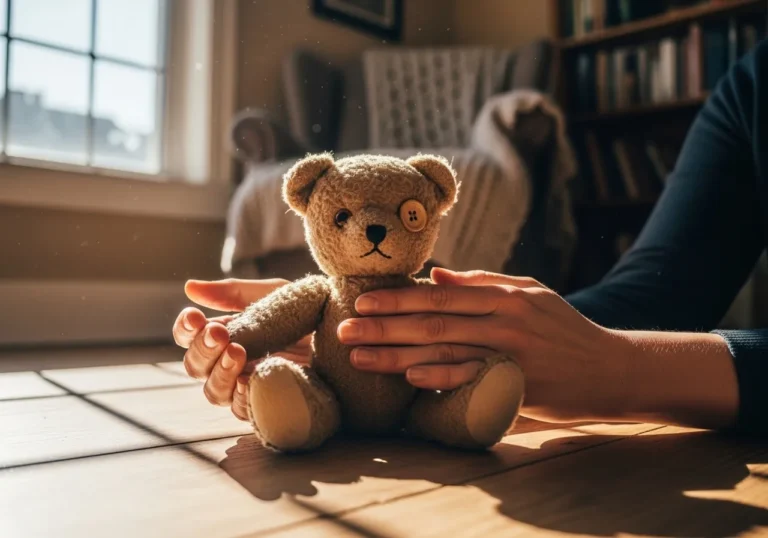
Our possessions often serve as extensions of our identity. They are tangible links to our past, present, and even our aspirational future. That box of college textbooks in the attic isn’t just taking up space; it’s a monument to your hard work and a younger version of yourself. The expensive workout gear you’ve never used represents the fit, active person you still hope to become. Letting go of these items can feel like letting go of a part of yourself or admitting defeat on a personal goal. This is a powerful emotional attachment to objects, where the item’s symbolic value far outweighs its practical use.
Loss Aversion and Fear of Regret
Psychologically, the pain of losing something is often twice as powerful as the pleasure of gaining something of equal value. This principle, called loss aversion, is a major driver of clutter. We worry intensely about future regret. “What if I get rid of this, and then I need it next week?” This fear can be paralyzing, leading us to keep items we haven’t touched in years on the off chance a very specific, unlikely scenario arises. The anxiety of potential regret often outweighs the immediate benefit of a clear, usable space.
The Role of Executive Function
Decluttering is a complex task that demands a high level of a specific set of mental skills. Experts refer to these as executive function—the cognitive processes responsible for planning, organizing, prioritizing, and making decisions. When you are stressed, tired, or overwhelmed, your executive function capacity is diminished. For individuals with conditions like ADHD or depression, these skills can be consistently challenging to access. Each item in a cluttered room represents a series of decisions: Keep? Donate? Trash? Repair? Relocate? When your brain is already running on empty, facing thousands of these micro-decisions can lead to total shutdown, making it easier to simply leave everything where it is.


22 Responses
This article was very informative and helpful for this phase in my life! I am a Public School Teacher, a retiree after 42 years of teaching! And as you may know, we are coneseuers of fine goods at home and at school! My mother died & my sister which means I have some of their goodies in my cluttered house! This article boosted my desire to get busy and declutter before I become a hoarder! My family already thinks I am! I am NOT! Thank you so much! 😊
This article was very informative and helpful for this phase in my life! I am a Public School Teacher, a retiree after 42 years of teaching! And as you may know, we are coneseuers of fine goods at home and at school! My mother died & my sister which means I have some of their goodies in my cluttered house! This article boosted my desire to get busy and declutter before I become a hoarder! My family already thinks I am! I am NOT! Thank you so much! 😊
Excellent…Thanks!
Sounds good
Hi this article l have read is a well defined explanation as to why we hold on to clutter.
Thank you for this step by step journey. I have alot of stuff from a 3bedroomm apt to a one bedroom apt to a room. I have been either totally overwhelmed by it all but the journey is pain. But what a cathartic feeling you get. Some of the stuff is emotional and l can’t believe l had two boxes with recycle shopping bags. Why?? lol
Anyway thank you
Cindy Donato
Toronto, Ontario Canada
Hi Cindy. I live in the U.S. I am in a similar situation, except my family and I still live in our 1 bedroom apt. We moved from a 3 bedroom duplex 16 yrs ago to our 1 bedroom unit, and we brought a lot of things from there. It’s very overwhelming. I have been trying to figure out how to declutter a lot of it. The stuff does make it look like we are hoarders, except that it’s not fully in the pathway of walking.
Thank you Cindy for sharing your experience. I also moved from a large space to a much smaller space. The home I lived in for many years had a first and second floors, a full walk in attic, a full dry clean basement, a shed, and a large garage. I moved to one floor small house. It has no attic, no basement, no second floor, no garage, and no shed. I am overwhelmed as you have said. During the moving process, ( I hate moving ) I let go of everything that I could at the time. But there is just no space for all that I have. I just piled evrything up out of the way best I could. Thinking I will address this later. I now have realized later will never come. There is just no room. So I am starting to face this. your comment was very helpful to me. I can see that I am not the only one dealing with this. Thank you.
This was a very informative article, helping me realize why I hold on to items often too long.
This article is informative to me. I’ m stuck with some of my stuff I had since 1994 , I came to the US from Africa.
Things that I still hold on to them continue to have strong memory, that I really don’t want to lose.
How can I print this article?
Printing this article is difficult under the best of circumstances. It is best to print one page at a time, in both portrait and landscape — and adding paragraphs not printed in pen or by copying to your email. Be sure to cross out all the ads that clutter the article (all the “Take quiz” or “Take test” or “Calculate” or “Print Now” ad buttons). The article itself seems to be good and seems to be sponsored by Hilton, but you will not be able to get a nice clean copy, just messy pages with cross-outs of ads.
One thing that helped me was that I heard that the main cause of cluttering was not having a place for everything, so that got me buying lots and lots of small plastic stackable bins, and labeling them.
Need to know
I too, am concerned that I am on verge of becoming a hoarder. As a property owner, I have witness half of my tenants become hoarders and I would spend a few thousand dollars cleaning out the unit after their demise. I am very interested to see a study how much advancement in technology and automation has to play with the amount of things we collect. I have come to accept that we all must die and that we cannot take any of these tangible items with us. Those we leave behind, does not want 98% of items we leave behind so they go into the trash or if someone thanks the item is of some value, they donate to charity. I am on a one year mission to get rid of 80 percent of the tangible items I have within the next 180 days. I want to be free as a bird and starts with letting go of stuff.
Craig, What a great response that you have shared. I am at the very same crossroad as yourself. I am not a horder. But I live in a small house, and have no room for the things I have. No basement, no second floor, no attic, and no garage. I love the homes I visit who have wide open space. Only the things needed for everyday living. Chair, table, desk, lamp, nothing else sitting around needing a place to be put away. Since there is no place for such items, they end being left where they are. I am going to put the things away, but this is not happening. So I have become aware that I need to address this before it becomes a real issue.
I have been retired and decluttering for 7 years now. It is best to handle everything one item at a time, to keep it or throw it away. Luckily, some things are no longer timely and their value has expired a natural death.
I expect to continue room-by-room in my condo for another 1-5 years and then I will become a beach bunny here on Maui!
Be persistent and remember this is what this time of life is all about!
This was very helpful and anxiety producing. I know all this but have a difficult time with it. I will try again because I know the clutter gets in my way.
This is very informative. I find that as I have aged over the years I have accumulated a sizable amount of ” things”. I have decided to opt for the addage ” you can’t take it with you ” now I have the emotional task of ridding myself of my ” things “.
I totally agree!
This is interesting facts to know because this is what I am dealing with right now as I get ready to move from one apartment to another. I want to be able to go with what I need and what I don’t.
I am so overwhelmed just reading this article!
I want to live a decluttered life…I really doubt know where to start!
I am truly stuck..please help
That info helped me
I could use some help going through all my loved ones that has passed away, and I inherited all their belongings.
My son‘s my mother, my daddy, my baby sister, my grandmother, and my daddy Ronnie, and my grandbaby have so many precious things trying to figure out what to do with them. I am making a craft room out of my sister’s room. She passed away the first of 2025 only 49 years old. I’m going to use that role also for a memorial room for special things, but I can’t keep them all need help.’